







What It Takes to Make Critical Mineral Recovery Bankable and Insurable

The energy transition will require roughly 6.5 billion tonnes of materials. Wind turbines, solar panels, batteries and power grids all depend on copper, nickel, lithium, cobalt and silver. For several of these metals, demand is approaching known reserves. For others, long lead times for new mines, export controls and highly concentrated supply are already creating bottlenecks.
Mining alone cannot close that gap. Today’s metals system is linear by design, built to extract, use and discard, and new extraction will not deliver the volumes or ore quality the transition requires. So what if we looked above ground first? Much of the metal we need is already in use in the “urban mine” of buildings, power lines and clean energy assets, and a major decommissioning wave is approaching.
On September 23, during NYC Climate Week, the Columbia Center on Sustainable Investment (CCSI) brought together the Carbon Trust, the Ellen MacArthur Foundation, Buckstop and Solas Capital to ask what it would take to recover that metal at scale and, crucially, to make doing so bankable and insurable
Why this matters
The metals system we rely on remains fundamentally linear, extraction‑dependent, and structurally incapable of delivering the volumes required for the energy transition. Lithium demand is expected to grow fivefold by 2040, and the IEA projects a 30% copper shortfall by 2035, as supply chains tighten under geopolitical pressure. Linear supply chains will not close that gap on their own.
But what if we looked above ground first? Wind turbines, solar panels and batteries hold large stocks of recoverable metal, and a major decommissioning wave is approaching. For example, end-of-life steel from EU wind assets alone is projected to grow roughly ninefold by 2030. Recovering such material is a supply-security strategy and a competitive advantage.
What we heard from our panelists
Ellen MacArthur Foundation made the case for metal recovery as a matter of resilience, value retention and long-term supply security. Drawing on its Missing Signal report on a circular economy for mobile phones in North America, it highlighted how upstream design choices make recovery economically viable across electronics and clean energy.
The Columbia Center on Sustainable Investment (CCSI) and the Carbon Trust presented Metals-as-a-Service (MaaS) as one way to close this gap. Instead of buying metal outright, users can lease it, turning upfront capital expenditure into predictable operating costs and gaining more secure access to supply. Because the owner keeps the metal and leases it for use, the owner is now accountable and incentivized to track and recover it. A special purpose vehicle (SPV) coordinates the value chain, and recovered metal builds a “metal bank” that monetizes metal cycles and supports future contracts. MaaS adapts a model already familiar from other industries, e.g. Chemicals-as-a-Service, Batteries-as-a-Service, Software-as-a-Service, and more. Over the past year, working with a Community of Practice, CCSI and the Carbon Trust modelled the economics behind it. See the presentation for how the numbers stack up in a modelled 400 MW wind farm [link].
Lenders cannot lend against, and insurers cannot underwrite, what they cannot measure. Buckstop explained how its Residual Value Intelligence platform tracks and measures critical minerals in deployed clean energy assets, providing the foundational data layer to support MaaS and other metal recovery models. Here is a 2 min. video about their Residual Value Intelligence. Learn more in this 10 min. video and book a demo here.
Solas Capital argued that recovery models can become bankable at institutional scale once material value is converted into visible, contracted cash flow, with commodity gains kept as upside, at least in early deals. Credit needs three things: creditworthy, paying customers; enforceable rights to the assets and materials; and an executable recovery route. Risk allocation comes first, and pricing follows. Sponsor equity should carry first-loss and unproven recovery risk, while senior debt needs familiar protections such as cash-flow-based amortization, reserve accounts, DSCR covenants and step-in rights. Solas Capital’s work in energy efficiency offers a precedent: it has brought institutional capital at scale to a previously underserved asset class by standardizing cash flows, aggregating assets and building diversified portfolios. The first deals should prove performance, build data and set the benchmark for lower-cost follow-on capital.
What the audience raised
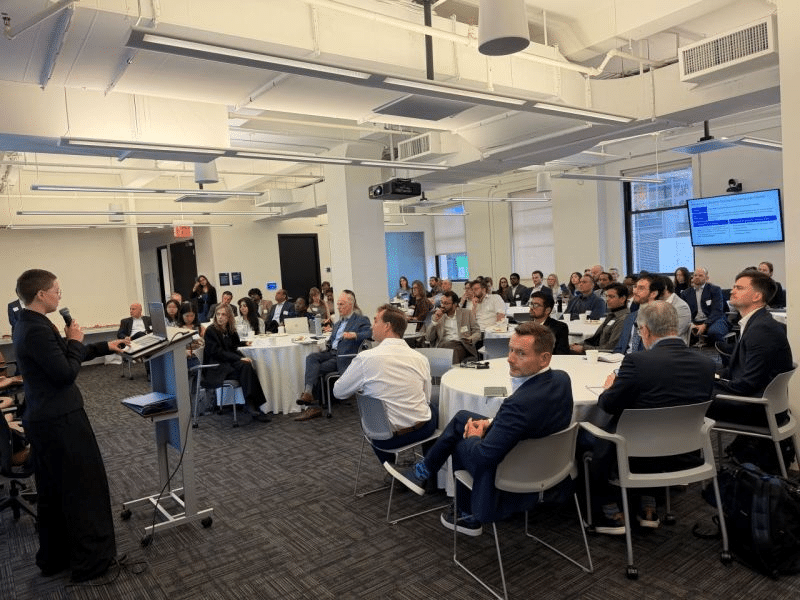
The questions from the floor were as valuable as the panel itself. One participant, drawing on a background in European eco-design regulation, asked what would actually motivate producers to design equipment for easy disassembly and recovery, given that design-for-disassembly often adds cost. The discussion pointed to MaaS itself as a mechanism, since retained ownership makes the producer invested in recoverability and the entire business model prices in the recoverability.
A participant from carbon markets asked whether avoided emissions could be factored into the value of recovered metal. The panel saw potential but urged caution, noting that carbon pricing remains contested and that recycling and reprocessing can create their own emissions, which complicates any simple savings calculation.
A founder from battery recycling pointed out that recovery and refining at commercial scale remain difficult, several recyclers have failed, and U.S. regulatory restrictions push material back to Asia for processing. The exchange underscored that financing structures and valuation data matter only if the physical recovery route is viable, and that processing needs more capital to become efficient and scalable. From the financing side, the point was that a lender needs confidence that a failed or underperforming actor in the value chain can be replaced, which is exactly the kind of structural protection that makes a deal underwritable.
Across the questions, one message was consistent. The barrier is rarely the technology alone. It is the alignment of incentives, data, policy, and capital around a recovery system that every stakeholder can trust. We take all of these questions, comments, and concerns with us as we continue our research journey, and we hope to be in touch soon.
We look forward to staying in touch!
For more information or engagement, please contact us at:
CCSI
Buckstop
Carbon Trust
charlotte.bucke@carbontrust.
Tsvetina.Chankova@carbontrust.
Ellen MacArthur Foundation
patience.williams@
seth.squadron@
jill.vandewalle@
Solas Capital