Corporate net-zero commitments have become the dominant framework for private-sector climate action, yet the proliferation of targets, methodologies,...
Diagnosing how the sovereign ceiling functions as a simplifying shortcut that can obscure meaningful differences across borrowers, and proposing an alternative credit rating approach based on disaggregating sovereign risk into specific transmission channels.
Diagnosing how the sovereign ceiling functions as a simplifying shortcut that can obscure meaningful differences across borrowers, and proposing an alternative credit rating approach based on disaggregating sovereign risk into specific transmission channels.
IZ
WW+3
Igor Zelezetskii and 5 more
Sovereign Risk Ceilings
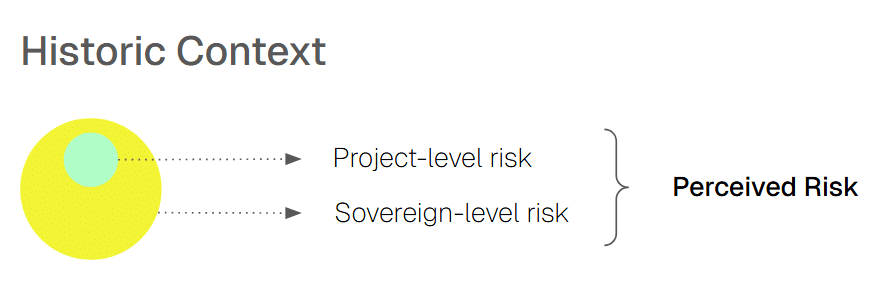
In international debt markets, the credit rating of a sovereign typically acts as a ceiling for all borrowers within that country. This briefing, enabled by the support of the Environmental Defense Fund, argues that the sovereign ceiling compresses meaningful risk differences across borrowers and can misrepresent actual default probabilities. By treating sovereign distress as uniformly transmissible across all domestic entities, it caps the cost of capital for issuers whose own credit position may be substantially stronger than the sovereign’s.
To illustrate both the nature of the problem and the urgency of addressing it, the paper focuses on non-sovereign issuers in EMDEs, particularly in capital-intensive, critical infrastructure sectors reliant on domestic revenue streams, including power and digital infrastructure.
Key Arguments
Typical exceptions to the sovereign ceiling rely on structural isolation mechanisms—such as offshore SPVs, future-flow securitizations, or diversified international revenue streams—that are generally inaccessible to domestic infrastructure borrowers earning predominantly local-currency revenues.
Absent demonstrable structural isolation mechanisms, the sovereign ceiling functions more as a heuristic than as an analytical conclusion. We call it methodological foreclosure. It assumes uniform transmission of sovereign distress across domestic borrowers, despite empirical evidence showing substantial variation in transmission channels and outcomes.
Sovereign risk travels through identifiable channels. Once disaggregated into specific transmission mechanisms, the risk to a given borrower becomes tractable rather than monolithic.
Many channels can be contained. Contractual design, financial structuring, and institutional arrangements can mitigate specific transmission risks. Where they do, the sovereign ceiling adds limited analytical value and may distort investment decisions.
Sovereign stress can affect domestic infrastructure borrowers. What matters is whether the pathways can be sufficiently contained to warrant credit differentiation above the sovereign. Where the answer is yes, a rigorous methodology should be able to recognize it.
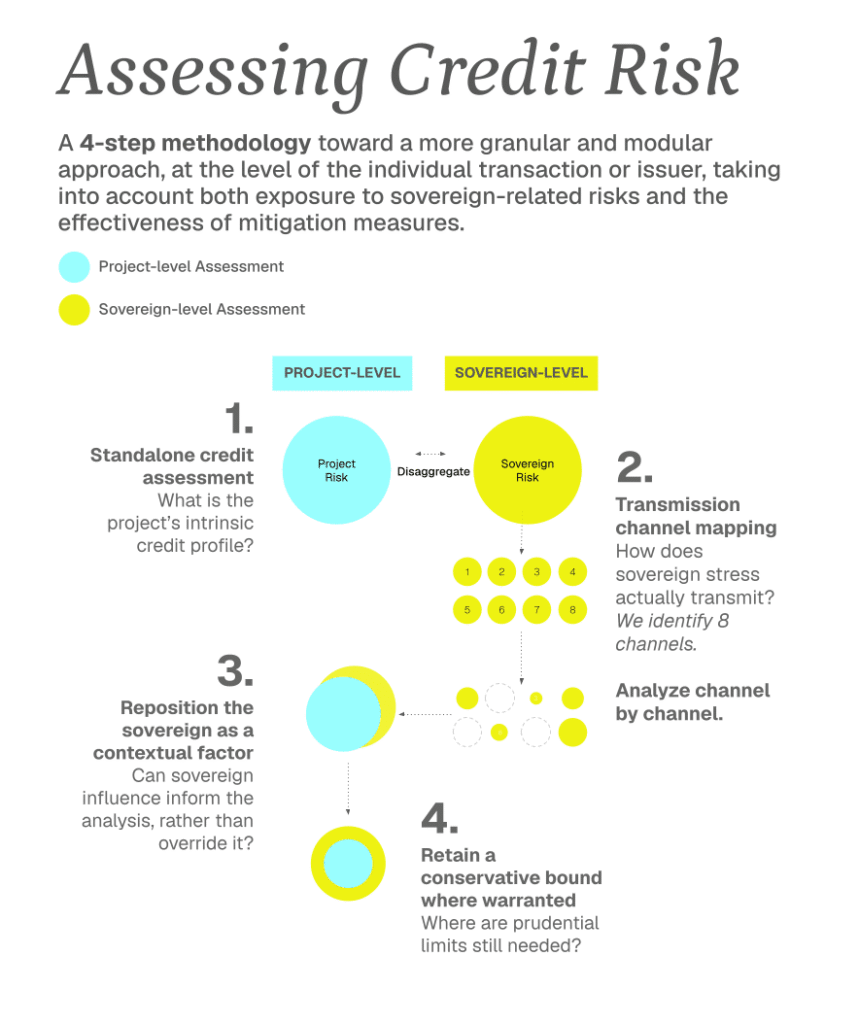
The paper offers a four-step analytical process to avoid the typical methodological foreclosure of credit rating methodologies:
The four-step framework is a more effective framework to assess credit risk at the level of the individual transaction or issuer, taking into account both exposure to sovereign-related risks and the effectiveness of mitigation measures.