Corporate net-zero commitments have become the dominant framework for private-sector climate action, yet the proliferation of targets, methodologies,...
Diagnosing how the sovereign ceiling functions as a simplifying shortcut that can obscure meaningful differences across borrowers, and proposing an alternative credit rating approach based on disaggregating sovereign risk into specific transmission channels.
Exploring the HVAC sector’s role in decarbonizing the built environment while meeting surging heating and cooling demand through a transition to low-GWP, PFAS-free refrigerants, stronger refrigerant circularity (recovery, reuse, and leakage prevention), and high-efficiency practices. CCSI’s guide maps these as a single, mutually reinforcing nexus, backed by credible transition plans.
Ben Baraga and 2 more
Extreme temperatures from climate change are increasing demand for heating and cooling systems across residential, industrial, and commercial sectors around the world. HVAC companies and policymakers find themselves in a high-pressure period of change to mitigate the mounting impact of the sector’s emissions.
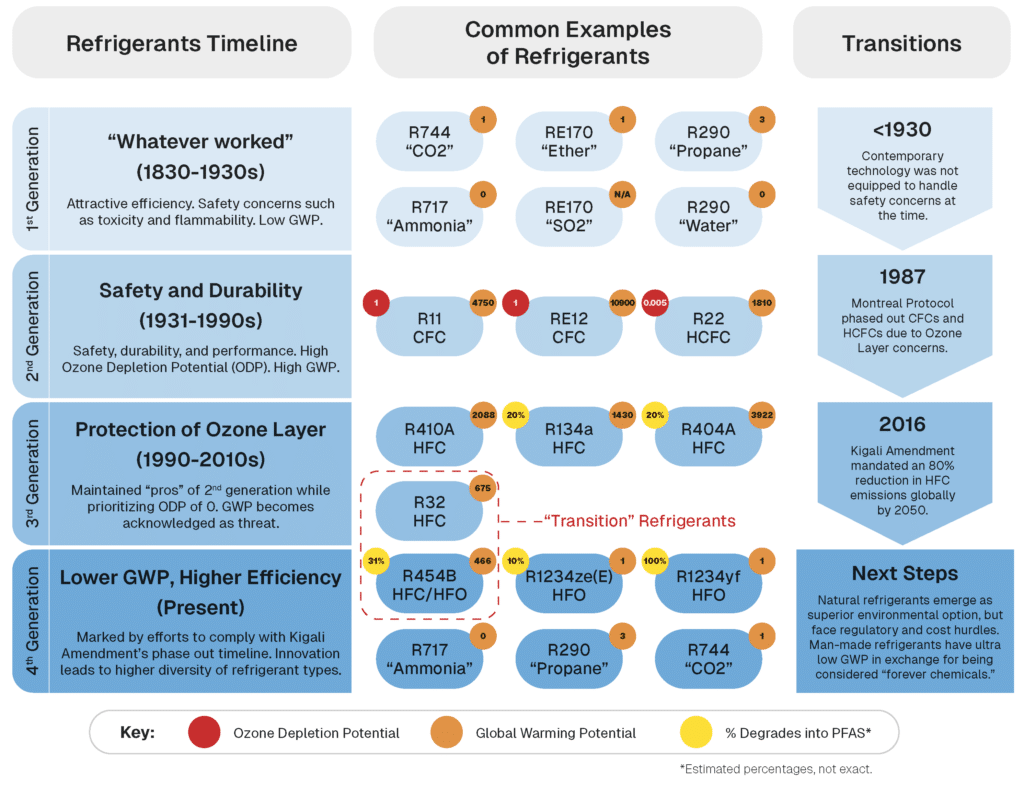
Periods of flux are nothing new to the HVAC industry—CCSI has mapped out the four generations of refrigerants in the table below.
Looming refrigerant and efficiency regulations in the coming decade require a careful, holistic transition plan. How do we achieve this synergy as we move beyond the 4th Generation?
We have developed a guide on the nexus between refrigerant choice, circularity, and energy efficiency. Our aim is to inform companies on developing stronger internal plans, while recognizing the need for coordinated policymaking.
The 3 Pillars of HVAC Sustainability
Refrigerant Transition entails selecting and deploying refrigerants in strict alignment with Kigali Amendment timelines while charting a clear pathway toward low-Global Warming Potential (GWP), PFAS-free refrigerants.
Refrigerant Circularity requires embedding circular design to minimize refrigerant charge, instituting robust end-of-life recovery and reuse, strengthening data collection and traceability to prevent leakage, and building technician capacity to implement these measures.
Energy Efficiency calls for accelerating the deployment of high-efficiency products, particularly heat pumps, to reduce operational energy use.
The Nexus
The above three pillars should be pursued as a nexus of mutually reinforcing actions, rather than as separate goals. An integrated approach is essential to avoid path-dependency and the lock-in of higher-GWP or PFAS-containing refrigerants, which can strand assets, raise retrofit costs, and delay subsequent transitions to lower-impact options.
Transition Plans
Comprehensive and robust transition plans are key to maintaining synergy among the three pillars, and should detail five core aspects: strategic ambition, metrics and targets, implementation strategy, engagement strategy, and governance.