Diagnosing how the sovereign ceiling functions as a simplifying shortcut that can obscure meaningful differences across borrowers, and proposing an alternative credit rating approach based on disaggregating sovereign risk into specific transmission channels.
Exploring how AI is reshaping sustainability transitions across planetary health, energy systems, industry and labor, finance, and democratic resilience — where the same capabilities that open new pathways also introduce systemic risks that no single sector can address alone. CCSI and Hitachi's report maps AI’s emerging risks and opportunities, and presents a global governance framework to manage this technological transition sustainably.
+1
Lara Fornabaio and 3 more
Sustainability transitions require deep, coordinated transformations across multiple sectors and social systems.
Artificial Intelligence (AI) is emerging amid converging global crises: climate change, biodiversity loss, geopolitical instability, and widening inequality. It is entangled with these challenges and is beginning to reshape their trajectories—in some instances amplifying risks, and in others opening new pathways—in ways that remain deeply uncertain.
Technology is what we make of it. While humanity has gone through several technological transformations in the past, governing AI poses a unique challenge, as the exact cause and effect, and therefore the predictability of these technologies, is unknown.
AI development is advancing faster than scientific understandings of its internal workings and the governance systems designed to oversee it. The “black box” nature of advanced models limits their auditability in critical areas such as natural resource management, biosafety, and finance. This asymmetry creates risk at an unprecedented scale.
The report situates AI within the broader framework of sustainability transitions, emphasizing that sustainable outcomes depend on complementary changes in institutions, governance, norms, and power structures.
Risks & Opportunities
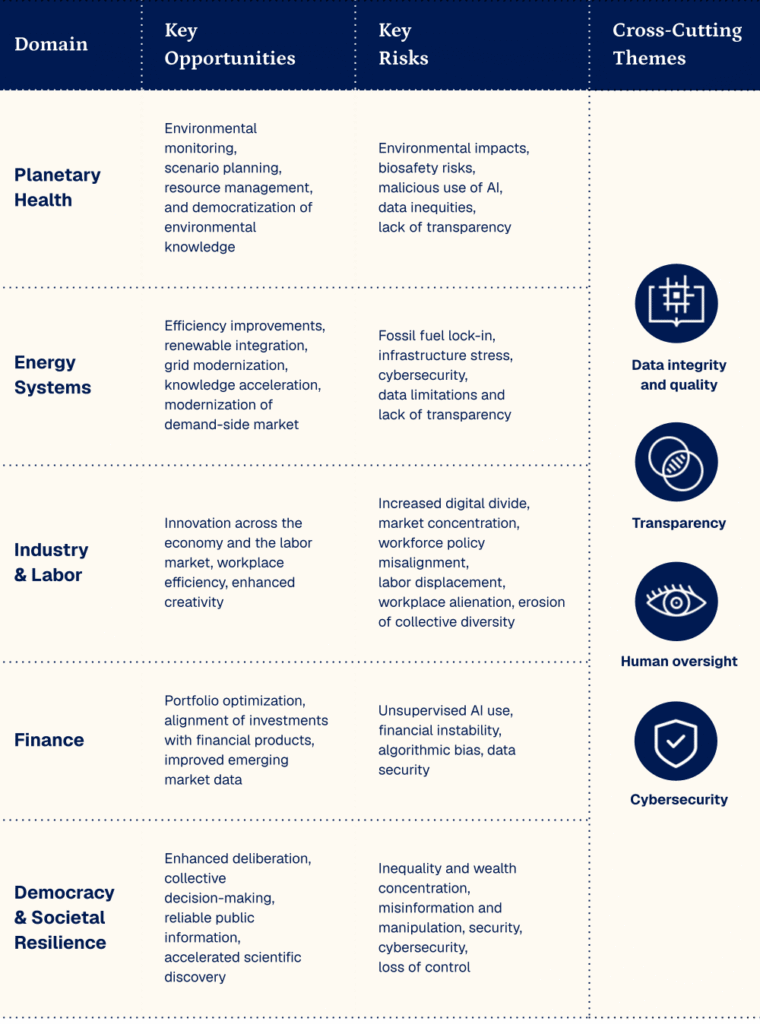
AI is rapidly reshaping how societies manage the environment, energy, labor, finance, and democracies. Across five domains, the report maps where AI can support sustainability transitions and where it risks worsening environmental damage, inequality, and systemic instability.
AI-related risks are not isolated phenomena. Environmental strain, financial fragility, labor disruption, democratic erosion, and security vulnerabilities are reflections of broader systemic challenges in governance and market concentration. And as AI systems become more autonomous, those risks become transboundary and potentially irreversible.
Addressing them requires not only sector-specific safeguards, but coordinated, cross-cutting governance responses.
Governance Framework
We propose a phased governance approach that evolves alongside the technology itself, with each phase building the foundation for the next.
In the near term (0–2 years), the priority is building a shared scientific foundation:
Operationalizing the UN AI Scientific Panel and creating a new interdisciplinary body, the AI Expert Technical Laboratory, to evaluate frontier AI models.
Establishing formal coordination mechanisms between those bodies to end the fragmentation that prevents evidence-based policy
In the medium term (2–4 years), utilizing the shared knowledge base to enable precautionary action:
Negotiating temporary restrictions on the highest-risk categories of AI research
Developing clear, measurable safety criteria that define when those guardrails can be lifted
Embedding multi-stakeholder governance mechanisms to ensure broad accountability
Over the longer horizon (4–6 years), durable institutions take shape:
Adopting a binding framework convention that sets core obligations for states while allowing flexible national implementation
Requiring certification for cross-border AI transfers, making responsible AI a condition of participation in global digital markets
The result is a governance architecture that evolves with the technology, instead of scrambling to catch up.
Our partners atHitachi have also produced a three minute artistic film on the theme of the joint research featuring a composition by Joshua Warner.
You may also watch a companion audio piece to help readers focus while reading the report, in this age of distraction. The video runs for approximately 60 mins and features ambient and experimental compositions by OHMA, Florian T M Zeisig, Róisín Berkeley, Cathal Berkeley, Christina Vantzou, John Also Bennett, Roméo Poirier, funcionário, Joy Guidry, Elizabeth Steiner, and Salamanda.
Both works were produced by Katsuto Tamagawa, Ichiro Mishima, Rentaro Hori, and Yudai Osawa, in collaboration with our co-author, Koji Sasaki.







 +1
+1