





ISDS on the Agenda: CCSI at the First Conference on Transitioning Away from Fossil Fuels
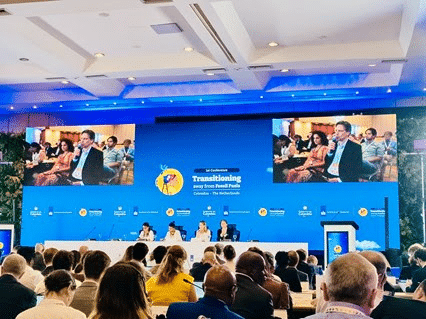
In the days before the First Conference on Transitioning Away from Fossil Fuels, convened in Santa Marta, Colombia, CCSI’s Ladan Mehranvar joined 220 economists and legal scholars in signing an open letter to President Gustavo Petro, urging Colombia to lead domestic and international efforts to withdraw from the investor-State dispute settlement (ISDS) system embedded in thousands of investment treaties worldwide.
This followed a CCSI co-convened conference in March 2026, examining the incompatibility of ISDS with a just energy transition. President Petro’s announcement that Colombia would withdraw from ISDS, was expected to set an example for other countries to follow.
The letter and Colombia’s response set the terms for what ISDS meant at Santa Marta: not an abstract legal concern, but a threat to host countries’ policy space. Because of the expansive protections built into these treaties, a legitimate regulatory decision — closing a coal mine, halting fossil fuel exploration, strengthening environmental law — can trigger ISDS claims worth millions or billions of dollars. Faced with that exposure, governments often avoid taking necessary action altogether, leading to regulatory chill. Colombia, which carries the highest ISDS exposure of any Amazon country, co-hosted the conversation, naming ISDS as one of its five priority pillars for the conference.
Conceived as a complement to the COP process, the Santa Marta conference was to be a space where States could speak openly and frankly about what a genuine fossil fuel transition requires. The conference was expanded to include an academic pre-conference and various stakeholder group chapters, including Indigenous Peoples, trade unions, NGOs, youth groups, women and diversity organizations, national and subnational governments, and the private sector, designed to feed analysis into the high-level ministerial sessions that followed.
Ladan participated in the academic pre-conference, which produced five concrete recommendations:
- Explicitly recognise that ISDS is a barrier to the just transition away from fossil fuels and the urgent need to address it collectively, in light of States’ obligations on climate change as outlined in the International Court of Justice’s advisory opinion.
- Commit to refrain from negotiating, signing, ratifying, or adopting national and international legal instruments that protect fossil fuel investments and include ISDS provisions.
- Commit to initiate termination of or withdrawal from legal instruments with ISDS and agree to carry out mutual termination of treaties, and neutralise the sunset clause, where a treaty partner so requests.
- Commit to initiate negotiations to stop protecting fossil fuel investments and eliminate ISDS in agreements between them, either through a new standalone plurilateral agreement or as part of a broader treaty.
- At Santa Marta, agree to launch and lead a working group with participation of affected communities, public interest organizations, vulnerable groups, academics, and Indigenous Peoples to collectively address ISDS as a barrier to the just transition away from fossil fuels and report back on progress in implementing these recommendations at subsequent conferences on the Transition Away from Fossil Fuels.
Those proposals reached the ministerial level. However, the co-hosts’ “takeaways” statement reflects the tensions between participating States: while ISDS is mentioned, it is done so cautiously, with disagreements over whether and how forcefully to confront it, keeping strong language out of the final text.
The conference’s most consequential outcome for this issue is that ISDS has been formally placed in an ongoing intergovernmental forum and potentially a State-led working group. This means that it will be on the agenda at the next convening expected in Tuvalu in 2027. For a mechanism that has long operated outside public and political view, getting ISDS on the agenda is a meaningful shift, allowing for potentially-new strategies where previous reform efforts have only offered marginal improvements. It also reflects years of work building the intellectual foundations on the real costs and (minimal, if any) benefits of ISDS provisions in treaties, and what it will take for countries to exit the system.