






The Infrastructure of Intelligence: Rethinking Energy Systems in the Age of AI
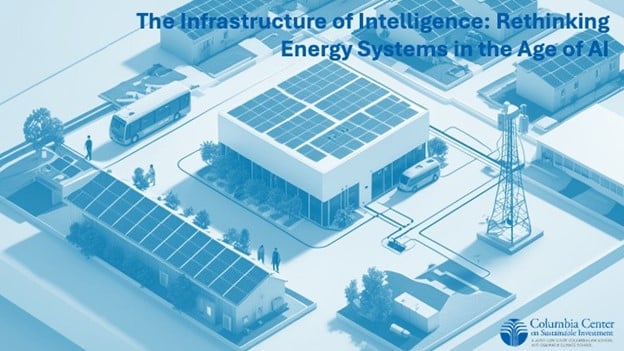
The world’s energy systems and digital infrastructure are undergoing rapid and interconnected transformations. The continued expansion of data centers – driven by growing demand for cloud computing, artificial intelligence, machine learning, and next-generation digital services – is fueling a rapid and significant rise in energy consumption in certain markets, with implications for global energy systems. At the same time, the suite of digital technologies supported by these data centers is reshaping the very design, efficiency, and resilience of the energy systems on which they depend – while also transforming essential public services across sectors including healthcare, education, food systems, transport, and financial services. Much of the global coverage of data center expansion has fixated – unsurprisingly – on concerns about grid reliability, electricity availability, and the climate implications of surging energy demand.
But that narrative misses the transformative opportunity of data center growth – particularly in light of the convergence of energy systems, digital infrastructure, and the sustainable development goals. Technology companies – especially hyperscalers – can play a unique role in our low-carbon, integrated energy future. Through their around-the-clock demand, their systems-level optimization tools, and their influence in digital connectivity, they can be essential partners in accelerating the global energy transition and shaping a more inclusive, resilient future.
There are three interconnected challenges that strategic cooperation between technology companies, policy-makers, utilities, and financial institutions can collectively address:
- Data centers require continuous, high-quality electricity, and increasingly demand that electricity be 100% zero-carbon. They also want to source component parts from suppliers powered by clean energy. Yet in many markets, especially emerging economies, this surge in clean electricity demand is outpacing system readiness, and grid decarbonization has been slow.
- Clean energy and energy storage projects face persistent financing and integration barriers. Despite declining technology costs, many renewable projects are stymied by delayed grid interconnection processes, siting challenges, and permitting delays, from the U.S. to Southeast Asia. These bottlenecks compound the underlying financial barriers. In EMDEs, high capital costs – often 3 to 5 times greater than in OECD countries – are a major reason why renewable energy remains cost-prohibitive. In developed countries, storage solutions that would facilitate renewable energy integration face persistent financing challenges due to uncertain revenue streams and high up-front costs.
- Digital inclusion remains uneven around the world – particularly in rural, underserved, or otherwise marginalized communities. Although digital tools are transforming the delivery of energy, health care, education, agriculture, financial inclusion, and transport, nearly 2.7 billion people still remain offline. This “digital divide,” if not resolved, risks entrenching existing inequalities just as innovation offers a new path forward.
This is where (& why) technology companies can play a transformative role. When embedded in strategic policy frameworks and coordinated with public and private partners, they can actively address these three challenges and unlock significant development dividends.
Anchoring Clean Energy & Storage Integration through Demand
The energy demand from data centers today is unusual: high, steady, and predictable demand with anticipated growth and an emphasis on zero-carbon sourcing. Without coordination, tech companies may opt for bespoke, off-grid power solutions – thereby bypassing national or regional systems that require strategic investment and financing for grid infrastructure upgrades and expansion. But, if integrated early with utilities and energy planners, their long-term procurement commitments can anchor the expansion of green grids and lower marginal costs for all users.
Critically, the reliability needs of hyperscalers also create a financeable demand for large-scale energy storage. Storage deployment has struggled globally due to uncertain and multi-layered revenue streams. Storage often relies on arbitrage, ancillary services, and capacity markets – each volatile in nature, and together insufficiently “bankable.” Long-term storage offtake contracts by data centers could generate dependable cash flows, making storage finally financeable at scale. While this financing model holds global relevance, it could be particularly transformative in emerging and developing economies (EMDEs), which often face more acute capital constraints and operate with less flexible grid infrastructure. Embedding storage solutions into early-stage grid design in these contexts enables leapfrog pathways toward clean, reliable, and resilient energy systems.
Beyond electricity, data centers require advanced water and cooling systems, that to date have been viewed as liabilities in contexts of limited resources. But water and cooling needs can also be reimagined as enablers. Learning from evolving practices in the mining sector, data centers’ need for water treatment and cooling systems can be leveraged to ensure access to affordable water and cooling infrastructure for surrounding communities. This approach has proven possible in the mining sector, where integrated, multi-user water systems have been successfully developed with clear governance, cost allocation, and operational arrangements. Data centers are already using captured heat waste to support district heating with substantially reduced emissions. With intentional integration, data centers can anchor broader community infrastructure, expanding access, building resilience, and reducing emissions and waste throughout the local/municipal system.
Energy System Optimization through Digital Technology
Technology companies are not only high-intensity consumers – they also produce the very tools needed to optimize and upgrade our energy systems. Such technological applications include:
- Smarter Grid Design: Identifying optimal sites for renewable generation, storage deployment, and transmission upgrades, to minimize costs and maximize reliability.
- Accelerated Interconnection: Streamlined interconnection review processes, reducing delays that slow clean energy deployment.
- Expansion of Distributed Energy (DE) Solutions: DE solutions require sophisticated technology to combine diverse sources of energy with smart control systems for ensuring decentralized solutions are reliable and resilient.
- Optimized Demand Response and Load Management: Leveraging AI to dynamically manage electricity demand, reduce peak loads, stabilize grids, and lower system costs.
- Preventive Maintenance: Leveraging real-time data with predictive analytics to detect issues early and optimize maintenance.
While promising, these technologies – like data centers themselves – have not been strategically or systematically deployed in most developed markets where they could markedly increase both energy and grid efficiency, reduce costs or delays, and improve resilience. As energy systems become more integrated, decentralized, and dynamic, many of these digital tools will become essential to ensure grid efficiency, resilience, and scalability. In emerging markets, integrating these optimizations early in grid design will allow those countries to leapfrog earlier technologies to develop smarter energy systems – both on and off-grid. But realizing their full value requires coordination with grid operators, regulators, and system planners – and ultimately with other off-takers from the grid to integrate the tools at the right points in development and ensure interoperability and a supportive regulatory framework.
Expanding Access to Broadband & Digital Solutions
Modern economies are rapidly digitalizing, with innovative digital tools bringing transformative benefits to health care, education, land use management and agriculture, financial inclusion, and transport systems, among other parts of the economy. In fact, universal access to broadband and digital services is increasingly recognized as foundational to achieving the Sustainable Development Goals. And yet, access to broadband and digital tools remains highly uneven, undermining access to valuable services and widening the digital divide.
Technology companies are strategic partners in expanding access to digital infrastructure, including data centers, fiber-optic networks, and wireless towers, that enable internet connectivity, data processing, and digital services. Just this year (2025), the IFC provided $100 million in debt financing to Raxio Group to expand digital infrastructure in Africa. In India, the National Broadband Mission 2.0 has set an ambitious goal of extending optical fiber to 270,000 villages by 2030, with strategically located data centers acting as the core nodes to distribute capacity across rural regions.
In more developed markets, data centers can serve as anchor tenants for broader digital infrastructure, catalyzing high-speed fiber-optic investments and other digital infrastructure that both serve the data centers and benefit surrounding communities.
As digital services expand, so does the demand for affordable, reliable electricity – tightening the link between broadband access, clean energy deployment, and inclusive economic growth.
A Strategic Path Forward
To view data centers as mainly energy-intensive off-takers misses their systemic potential as digital and energy infrastructure multipliers, serving as backbones for both grid and digital transformation. With appropriate cross-sectoral planning frameworks, policy development, incentives, and market design, data centers can help resolve the very constraints that hold back clean energy deployment, energy system efficiency, and universal digital access. In doing so, they can help deliver on national and regional climate and broader sustainable development goals.
At the Columbia Center on Sustainable Investment (CCSI), we are working with partners to design the policy and investment pathways that will allow these integrated models to scale. Building on our pioneering work in shared-use mining-related infrastructure, we are investigating the institutional, investment, and operational models that can support this convergence. Through high-level dialogues – such as the 2025 High-Level Convening on ASEAN’s Energy & Digital Future – and our ongoing collaborations across regions and sectors, we hope to shape a new approach to planning and policymaking that reflects the opportunities and imperatives of a connected, low-carbon economy.