






Mining, Metals and Resource-based Development
Before—and Beyond—the UN Guiding Principles on Critical Energy Transition Minerals
Download Resources
On September 11, 2024, the UN Secretary-General’s Panel on Critical Energy Transition Minerals published seven Guiding Principles on Critical Energy Transition Minerals, providing recommendations for governments, the private sector, civil society, and other stakeholders. In UN Secretary-General Antonio Guterres’ words, the principles “ground the renewables revolution in justice and equity, so that it spurs sustainable development, respects people, protects the environment, and powers prosperity in resource-rich developing countries.”
At CCSI, we welcome the adoption of the principles. They build on decades of work, advocacy, and engagement by many organizations; continued engagement with stakeholders will raise their ambition and strive toward their realization. This commentary illustrates how they build on the research, advisory, and capacity-building work CCSI has been leading for over a decade, alongside a wide range of partners, to improve mining sector governance for sustainable development in resource-rich developing countries and secure the responsible supply of critical minerals needed for a just energy transition globally. From this vantage point, we close by describing how we envision building on the Guiding Principles.
Our free, self-paced, massive open online courses (MOOCs) Natural Resources for Sustainable Development and Mining and Materials for Sustainable Development Transformations provide a comprehensive introduction to mining governance challenges in the context of the energy transition and evidence the importance of, and intersectionality among, the seven principles.
Principle 1: Human rights must be at the core of all mineral value chains.
Human rights are at the core of CCSI’s mining and energy work. We have supported governments in conducting human rights impact assessments (HRIAs) for mining projects and developed policy and research on best practices around community development requirements in laws and community development agreements (CDAs).
We have also conducted research and provided support to stakeholders on the politics of free, prior and informed consent (FPIC), and the incorporation of FPIC into investment approval processes and mining contracts.
In support of a rights-based approach to renewable energy deployment, we published a Briefing for Policymakers on Protecting Human Rights in Renewable Energy Projects as well as a Business Guide and Legal Risk Primer for Commercial Wind and Solar Project Deployment.
Principle 2: The integrity of the planet, its environment, and biodiversity must be safeguarded.
Early after the adoption of the 2030 Agenda, CCSI was the first to map mining to the SDGs, together with the WEF and UNDP, creating a shared understanding of how mining can contribute to their achievement. Since then, we have done deep dives into particular intersections of mining and the SDGs.
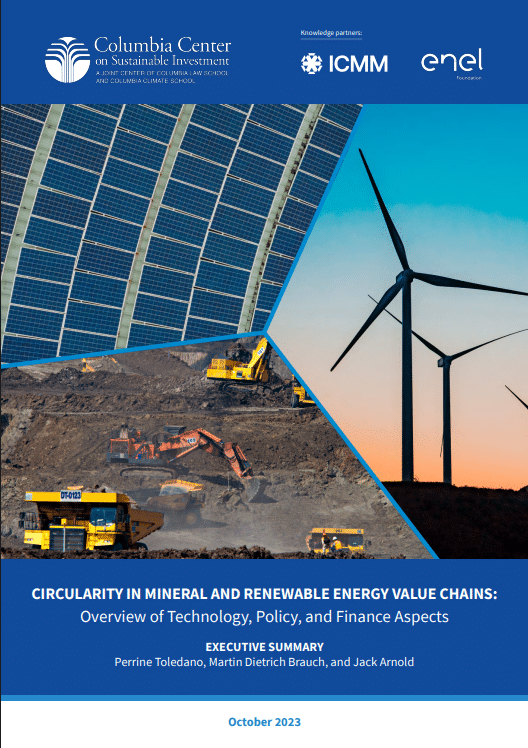
Acknowledging the need to shift to a circular economy to achieve sustainable development and decarbonization, we studied post-mining land-use potentials and partnered with industry leader ICMM to explore technology, policy, and finance conditions and reforms needed to enable circularity in the mineral value chains of solar panels and wind turbines. With UNIDO, we are also conducting a market assessment of innovative clean energy technologies in the mid- and downstream segments of critical minerals value chains in developing countries.
To support the decarbonization of upstream mining extraction activities and enhance their contribution to climate adaptation, we pioneered recommendations for integrating renewable power into mining operations and climate change mitigation and adaptation clauses into investor–state mining contracts. To help reduce the carbon footprint of hard-to-abate industries mid- and downstream, we have done extensive work on GHG accounting and decarbonization strategies for the steel and aluminum industries. To support climate and other environmental goals throughout critical minerals value chains, as part of a consortium of partners, we developed the IFC Net-Zero Roadmap to 2050 for Copper and Nickel Value Chains—deriving important lessons relevant to other critical minerals.
Finally, to better understand and address the environmental impacts of mining, we have worked on assessing water-related risks in mining investments and studied the political realities shaping environmental impact assessments (EIAs) to inform more effective approaches to safeguard the environment.
Principle 3: Justice and equity must underpin mineral value chains.
CCSI has long studied the processes and impacts of job creation in the mining sector and suggested policies to improve employment outcomes. Our work is also attentive to equity and distributive and procedural justice aspects of investments in mining and the energy transition.
Our comprehensive Global Guidance for Just Transition Policy provides recommendations to help shape further guidance on just energy transition policymaking from international institutions to support developing countries in key policy areas, including public participation, decent employment, social protection, human rights, and access to affordable and sustainable energy.
Principle 4: Development must be fostered through benefit sharing, value addition, and economic diversification.
Investments in mineral value chains must contribute to economic growth and development—a point that CCSI’s work consistently stresses, for example, in its support of transparency and equity in fiscal frameworks, to ensure that adequate taxes and royalties from mining investments contribute to the host state’s sustainable development.
Our Getting a Good Deal MOOC and our Negotiation Support Portal provide guidance for governments on how to plan and prepare for mining investments, negotiate the main terms governing them, and monitor and manage them, with a view to maximizing their positive contribution to sustainable development and minimizing their impacts.
We have examined the economic prerequisites to attract first-degree downstream beneficiation industries and the extent to which these industries have contributed to further domestic linkages. We have also discussed the fundamental importance of the mining–energy–industry feedback loop for African countries.
Our pioneering and longstanding strand of work on open-access or shared-use infrastructure projects built for mining investments—including railway, port, power, water, and telecommunications infrastructure—has highlighted how such projects can be structured in a way that leads to sustainability co-benefits for mining communities and states.
Principle 5: Investments, finance, and trade must be responsible and fair.
Legal, policy, and financial frameworks at domestic and international levels are fundamental to well-governed critical minerals value chains. At CCSI, we have been following the implications of international investment law for mining sector investments and providing guidance to governments on how to curb the negative impacts of investment treaties and investor–state dispute settlement (ISDS) on the governance of critical minerals for a just energy transition.
The objective of our expanding work in sustainable finance is to shape the rules governing the financial flows available for investment in critical minerals and other sectors crucial to achieving sustainable development and climate objectives.
Principle 6: Transparency, accountability, and anti-corruption measures are necessary to ensure good governance.
Well beyond acknowledging the need to make contract transparency a standardized and meaningful norm leading to better accountability in mining value chains, CCSI has been at the forefront of promoting it in practice. With partners, we have developed searchable repositories of publicly available investor–state mining contracts at ResourceContracts.org and of community–investor agreements at OpenCommunityContracts.org.
In parallel, we have examined the pros and cons of mining governance regimes primarily based on contracts vis-à-vis legislation-based licensing regimes, evidencing the trend in developed countries toward more legislation, which is conducive to greater transparency and accountability.
As part of our study on the politics of extractive industries, CCSI has worked on the politics of transparency and accountability and developed politically informed approaches to anti-corruption.
Principle 7: Multilateral and international cooperation must underpin global action and promote peace and security.
CCSI strongly supports multilateralism and international cooperation mechanisms to meet the global challenges of advancing and governing investment in a just energy transition. In fact, we have proposed the adoption of principles on the governance of energy investment, and we have proposed a framework to build cohesion among the various areas of international law that are relevant to climate-aligned investment governance.
What’s Next for the Sustainable Governance of Investment in Critical Minerals?
The seven principles published by the UN Secretary-General’s Panel build on and consolidate many of the results of the research, advocacy, leadership, and engagement by and among stakeholders in mining value chains over the past couple of decades. This was a critical and necessary step, particularly as critical mineral value chains were thrust into the spotlight by the mineral-intensive energy transition and other sustainable development transformations. Yet, more work is needed to operationalize them, implement the actionable recommendations made by the panel, and take other key steps to realize the long-held goals of just, equitable, and sustainable resource-based development.
As the Guiding Principles are launched and discussed, we urge a critical reflection on why achieving these principles has been so hard in practice, despite many successive sets of standards, convenings, and even catastrophic failures of governance and practice. Where have we seen successes, and where (and why) do disputes persist? Are there policies we can learn from and replicate, or others that were not as successful as we had hoped? What new thought leadership is needed to meet the moment, and ensure that thoughtful innovation—in policies and practices—guides the sector toward sustainability amidst technological and geopolitical turbulence?
CCSI looks forward to continued collaboration with our partners in government, industry, finance, and civil society, to turn these ambitions into reality.