A Specialized Guarantee Facility for Industrial Decarbonization: The Case for a Dedicated, Pooled Risk-Sharing Instrument
This blog was originally published on Illuminem, and has been co-authored with Rhian-Mari Thomas. She is the CEO...
This blog was originally published on Illuminem, and has been co-authored with Rhian-Mari Thomas. She is the CEO...



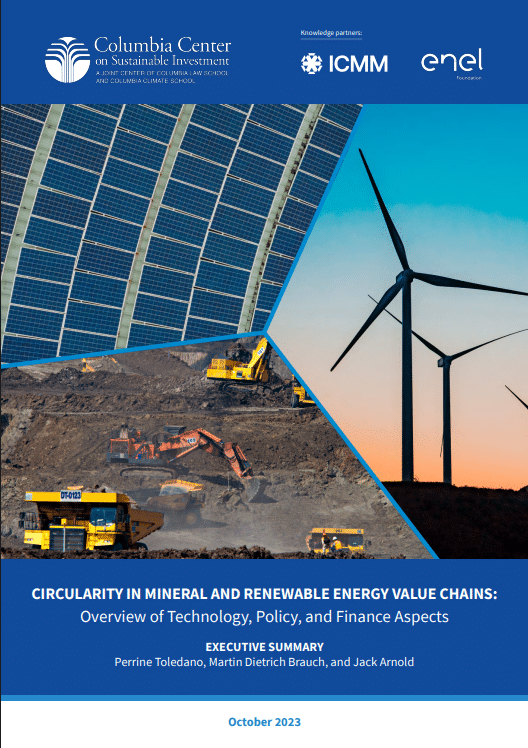
The global transition to renewable energy systems will be mineral intensive and, under the current linear economy conditions,...


In the first of five expert interviews related to CCSI’s work on scaling renewable energy investment, we interviewed Gauri Singh to understand more about the role of national energy roadmaps. Gauri Singh is the Deputy Director-General of the International Renewable Energy Agency (IRENA). She has more than 30 years of experience in policy, advocacy, and project implementation within the field of renewable energy and sustainable development from India and the international system.
Read CCSI’s recent publications on scaling renewable energy investment.
The impressive decline in costs of renewables (especially solar and wind) in the last decade has led to the increasing size of projects. Currently, a typical project size would be in hundreds of MW. The investor is thus looking at deploying substantial capital for 20–25 years in these assets. The long-term vision of the country, as reflected in the national energy roadmap, is a critical parameter in investment decisions. It is often a necessary but not sufficient condition.
A well-designed national energy roadmap should be comprehensive and reflect the following:
Often the mandate for national energy roadmaps lies diffused between many ministries, and no mechanism exists for coordinating inputs from different entities. Also, now that the energy transition is being considered as an economy-wide phenomenon, not just about electrification, this aspect becomes even more pertinent. Institutional capacity to coordinate and project scenarios are also important.
While capacity building will help, and the business case now for the shift is clear, a coordinated approach on energy always starts with a strong political will and vision.
The National Solar Mission in India in 2010 had all the elements required to kickstart a nascent sector and build an ecosystem with strong independent power producers (IPPs), financial institutions agreeable for lending to renewable energy, a manufacturing base, regulations for the must-run sector, and an understanding of the grid integration in grid operators and distribution companies (discoms).
Brazil also had good master plans for renewables deployment, with auctions for solar and wind and a strong policy and business ecosystem to promote biofuels.
IRENA is a centre for excellence for renewables and has in the last decade provided countries with analytics around all aspects of renewables, helped them understand their resources, built capacity for long term energy planning and provided detailed assessments for policy actions and measures required to deploy renewables. While IRENA focuses on the global landscape, it also has a huge body of work at the regional and country levels to provide tailored advice. As the voice of renewables, IRENA has shared best practices with its near universal membership, and provided thought leadership in emerging areas of work like geopolitics of renewables, technology trends and innovation.
Although global investment in energy transition technologies reached a new record of USD 1.3 trillion in 2022, we still have a long way to go – yearly investments must more than quadruple to over USD 5 trillion.
As IRENA’s global mandate to accelerate renewables-based energy transitions becomes more critical than ever on the road to 2030, IRENA’s Medium-term Strategy for 2023 to 2027 sets out a new direction for the Agency, focused on urgent and targeted action, unparalleled international cooperation, and continuous innovation – all of which contribute to greater investment.
We will continue the focus on enhancing human welfare and driving an urgent and systemic shift for increased energy access, reduced inequalities, improved energy security, and prosperous and resilient economies and societies – issues which are especially pertinent to developing countries.
To read the other expert interviews in the Scaling Renewables series and CCSI’s reports on scaling investment in renewable energy, visit our project page.
Documents