Time and Compromise in UNCITRAL’s Working Group III
During the week of 22 September 2025, States once again met in Vienna under Working Group III (WGIII)...

During the week of 22 September 2025, States once again met in Vienna under Working Group III (WGIII)...


The global transition to renewable energy systems will be mineral intensive and, under the current linear economy conditions,...


Exploring the HVAC sector’s role in decarbonizing the built environment while meeting surging heating and cooling demand through a transition to low-GWP, PFAS-free refrigerants, stronger refrigerant circularity (recovery, reuse, and leakage prevention), and high-efficiency practices. CCSI’s guide maps these as a single, mutually reinforcing nexus, backed by credible transition plans.



Extreme temperatures from climate change are increasing demand for heating and cooling systems across residential, industrial, and commercial sectors around the world. HVAC companies and policymakers find themselves in a high-pressure period of change to mitigate the mounting impact of the sector’s emissions.
Periods of flux are nothing new to the HVAC industry—CCSI has mapped out the four generations of refrigerants in the table below.
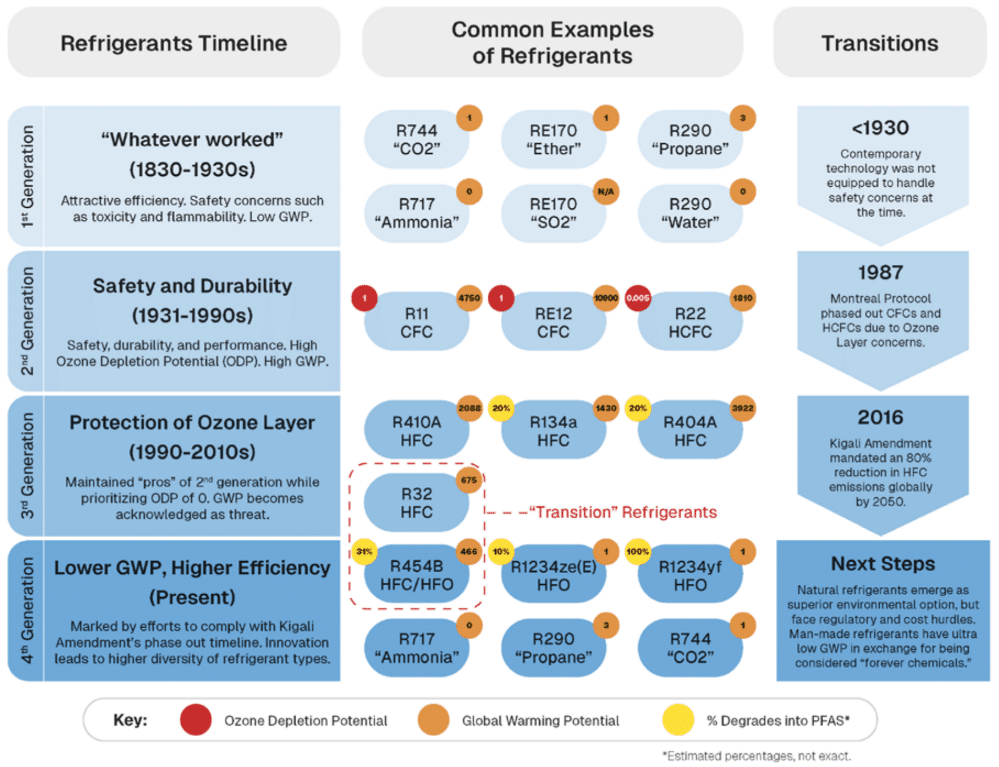
Looming refrigerant and efficiency regulations in the coming decade require a careful, holistic transition plan. How do we achieve this synergy as we move beyond the 4th Generation?
We have developed a guide on the nexus between refrigerant choice, circularity, and energy efficiency. Our aim is to inform companies on developing stronger internal plans, while recognizing the need for coordinated policymaking.


The above three pillars should be pursued as a nexus of mutually reinforcing actions, rather than as separate goals. An integrated approach is essential to avoid path-dependency and the lock-in of higher-GWP or PFAS-containing refrigerants, which can strand assets, raise retrofit costs, and delay subsequent transitions to lower-impact options.

Comprehensive and robust transition plans are key to maintaining synergy among the three pillars, and should detail five core aspects: strategic ambition, metrics and targets, implementation strategy, engagement strategy, and governance.