Time and Compromise in UNCITRAL’s Working Group III
During the week of 22 September 2025, States once again met in Vienna under Working Group III (WGIII)...
During the week of 22 September 2025, States once again met in Vienna under Working Group III (WGIII)...

The global transition to renewable energy systems will be mineral intensive and, under the current linear economy conditions,...


ASEAN stands at the precipice of a watershed moment. The region has the opportunity to show the world how to effectively coordinate as a regional community in support of the competing priorities of decarbonization and development. With energy demand projected to more than double by 2050, the region has a rare chance to leapfrog legacy systems—which are so often fragmented and inefficient—to build an integrated, clean energy system. In doing so, it could save substantial energy costs, optimize capital deployment, and support competitive, low-carbon, next-generation industries throughout Southeast Asia. The recognition of this opportunity is evident. As ASEAN Member States convene in Kuala Lumpur over the course of 2025 to coordinate a number of landmark efforts, the ASEAN Secretariat and AMS have prioritized two important efforts: An Enhanced MoU for the ASEAN Power Grid, and a new, shared ASEAN Community Vision 2045. The ASEAN Power Grid (APG) Consultative Committee is currently in the final steps of renewing the APG Memorandum of Understanding. The ‘Enhanced MoU’ will be finalized in October 2025. It envisions a strengthened mandate and capacity to deliver on the Member States’ shared vision for a “more globally competitive and seamlessly integrated single market,” including the interconnected grid as the backbone for broader regional energy integration in ASEAN. Both documents reinforce ASEAN’s recognition of regional integration as imperative for the success of the regional economy and the interrelated impacts on efforts related to climate mitigation and carbon removal. As is evident, ASEAN is primed for a collaborative, regional approach to energy planning and financing that could define its development trajectory for decades to come.
Delivering on this opportunity will require more than the globally standardized strategy of patchwork incentives, financing, and public and/or private sector activity. To lead the world, ASEAN must pursue, and coordinate the financing of, a fully integrated, multi-sectoral, regional low-carbon energy system designed to cut emissions, increase resilience to shocks, and ensure that the benefits of the transition are distributed equitably. At the core of any integrated energy system is the grid, which is the most essential tool for enabling regional power cooperation. When effectively implemented, it supports multilateral electricity trading, demand balancing, and the efficient use of renewable energy across borders. But the grid alone is not enough. Without integrated planning across the wider energy system and the economy as a whole, even the best-designed power market risks becoming a sink—generating supply without matching productive demand. A regionally interconnected grid only delivers its full value when aligned with coordinated upstream and downstream planning: from generation and storage, to industrial development, digital infrastructure, and the spatial distribution of demand. If done effectively, the APG will become the backbone of ASEAN’s energy transition and comprehensive economic transformation.
The transformative potential of regional energy integration took center stage at the 4th International Conference on Financing for Development (FfD4) in Seville. For the first time, the Financing for Development Outcomes Document (known as the Compromiso de Sevilla) repeatedly emphasizes the value and importance of regional platforms, institutions, and mechanisms in delivering sustainable finance at scale and the potential for regional integration to accelerate sustainable economic development.
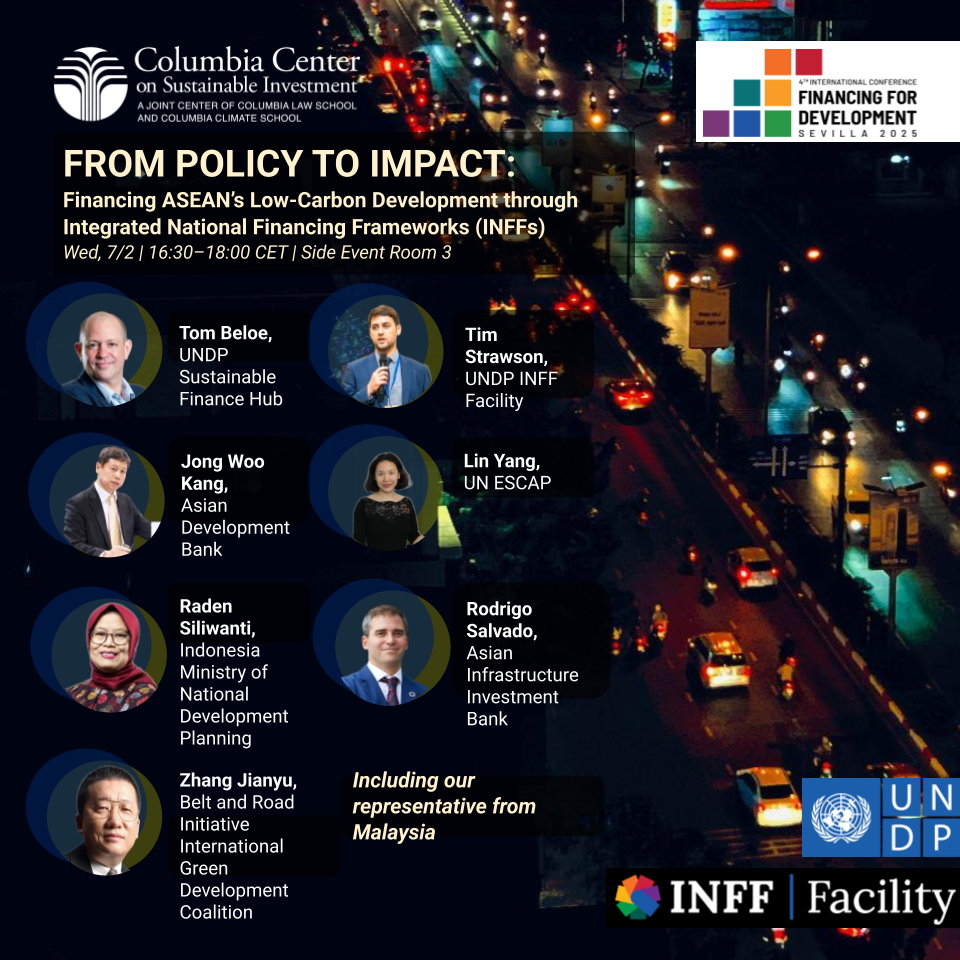
As evidenced above, ASEAN is already preparing to answer this call. Beyond the landmark efforts under the 2025 Malaysian Chairmanship, the ASEAN Centre for Energy (ACE) already produces—along with the ASEAN Energy Outlook and the ASEAN Interconnection Masterplan Study—an ASEAN-led plan of action (the ASEAN Plan of Action for Energy Cooperation, or “APAEC”). It now needs detailed technical pathways for an integrated energy system, coherent institutional arrangements to enable these development efforts, and an integrated financing strategy to mobilize the required investment and de-risk or otherwise make the infrastructure projects of the next 20-30 years bankable. This was the focus of a high-level panel at FfD4, hosted by the Columbia Center on Sustainable Investment (CCSI) and UNDP, and moderated by CCSI’s Director, Lisa Sachs. The panel included Mr. Jianyu Zhang, Executive Director of the BRI International Green Development Coalition; Ms. Raden Siliwanti, Director for Multilateral Funding, BAPPENAS, Indonesia; Ms. Lin Yang, Deputy Executive Secretary, UN ESCAP; Mr. Jong Woo Kang, Director of Regional Cooperation and Integration, Asian Development Bank; and Mr. Rodrigo Salvado, Director General, Operational Partnerships, Asian Infrastructure Investment Bank; and Mr. Charles (Chongguang) Yu, SDG Finance Policy Advisor, UNDP.
The panelists resoundingly affirmed the tremendous opportunity for energy integration in ASEAN, particularly given the unique political moment. At the ASEAN Summit in May 2025, the ASEAN heads of state made an explicit commitment to accelerating regional energy and economic integration as a foundation for long-term development and climate alignment. That same month, ASEAN, China, and the Gulf Cooperation Council announced a historic agreement to deepen cooperation on energy transition, connectivity, and trade, including commitments to jointly develop low-carbon supply chains and resilient regional infrastructure.
Despite growing political support for regional integration, the reality on the ground remains complex. ASEAN’s energy landscape is crowded with overlapping initiatives, institutions, and external development programs, many of which operate independently, reinforcing fragmented planning rather than enabling coordinated progress. Long-standing intentions to connect energy systems across borders have seen stalling progress. Just half of the planned electricity interconnectors have been built. Only a few multilateral power trade projects have reached operational status. Annual clean energy financing across the region must rise fivefold—reaching $190 billion by 2035—to support transmission, interconnection, and systems infrastructure.
A common challenge cited by stakeholders is the misalignment between national interests and regional agendas. But the approaches of the region’s development and institutional partners, whose programs remain largely nationally focused, exacerbates this misalignment. Even when the benefits of regional integration are widely acknowledged, these approaches might be inconsistent with the partners’ institutional mandates or responsiveness to the Member States’ stated priorities.
This fragmentation and reinforcement of domestic interests has led to inefficiencies at multiple levels. ASEAN has experienced duplicated reserve margins, stranded asset risks from uncoordinated national investments, and opportunity costs in developing competitive industrial and low-carbon sectors, especially as global supply chains shift toward clean energy. Panelists described how project preparation resources have been spent on infrastructure designs that, while technically sound, fail to reach implementation because they lack alignment with regional frameworks or the necessary enabling conditions. As a result, concessional finance has been deployed inefficiently, and regional investors have lost confidence in pipelines that appear uncoordinated and piecemeal.
Prime Minister Anwar Ibrahim of Malaysia, this year’s Chair of ASEAN, has prioritized the development of a coherent vision and roadmap for a regional, integrated, low-carbon, competitive energy system, to achieve the region’s energy and economic goals and address the fragmentation and political barriers to date. CCSI and the UN Sustainable Development Solutions Network are working with ASEAN institutions—most notably the aforementioned ASEAN Centre for Energy (ACE)—to advance this vision, starting with a technical model of what such an regional, multi-sectoral integrated energy system would look like and its potential benefits to all ASEAN Member States. The technical work would be accompanied by the development of an institutional and financing framework capable of coordinating national pathways, mobilizing regional investments, and enabling the cross-border infrastructure, governance, and digital architecture necessary for ASEAN’s energy and economic transformation.
The panelists at the high-level FfD4 session advanced several actionable proposals for this coherent institutional and financing framework. Panelists suggested how standardized legal frameworks, such as model power purchase agreements, wheeling charge protocols, and environmental permitting norms would help reduce transaction costs, mitigate risk, and attract private sector participation. They also suggested the creation of a regional project preparation facility to help ASEAN governments screen, prioritize, and structure infrastructure projects aligned with regional needs, avoiding wasted costs in preparation for projects that were unviable or misaligned with regional plans. While there are certainly opportunities for private sector investments in the grid, the panelists underscored that public institutions need to design the institutional and financing pathway, creating the enabling conditions for private sector finance. A regional financing platform could also usefully provide first-loss capital, currency hedging, and credit enhancements specifically for cross-border projects, where unique risks of transborder projects deter private investments.
Mr. Kang noted that a macroeconomic model of regional energy interconnection—especially contrasted with a counterfactual without interconnection—could help to align domestic energy and economic interests with regional plans, as such a model would demonstrate (and ensure) that regional integration is a net-positive for each Member State (and for sub-national regions, which have their own energy and economic interests and play a particularly important role in managing permitting, land access, and local infrastructure deployment).
Lin Yang, Deputy Director of the Energy Division at UN ESCAP, proposed convening a regional version of the Financing for Development conference, focused specifically on designing and advancing a regional financing platform for ASEAN. This would provide a dedicated forum to align development partners, and public and private financial institutions around regional priorities, in support of a more coherent, integrated, and efficient financing strategy.
Charles (Chongguang) Yu, SDG Finance Policy Advisor at UNDP, underscored UNDP’s support for country-led development, supported by strong regional and international cooperation. For instance, UNDP’s Integrated National Financing Frameworks (INFF) can support both countries and regional institutions to align financing with national and regional priorities and to foster collaboration among public and private financial institutions.
A shared conviction emerged from the panel: ASEAN’s clean energy future is achievable, and can become a model for regional cooperation. By building integrated systems that deliver both climate alignment and economic transformation, ASEAN has the opportunity to shape an energy architecture that meets the needs of its people, strengthens regional resilience, and demonstrates new pathways for sustainable development. Realizing this vision will require bold leadership, institutional coherence, and a new generation of regional planning and coordinated financing strategies.