Time and Compromise in UNCITRAL’s Working Group III
During the week of 22 September 2025, States once again met in Vienna under Working Group III (WGIII)...

During the week of 22 September 2025, States once again met in Vienna under Working Group III (WGIII)...

The global transition to renewable energy systems will be mineral intensive and, under the current linear economy conditions,...


Increased investment in agriculture and food systems—from both the private and public sectors—is critical to enhance food security and nutrition, reduce poverty, and adapt to climate change. To generate sustainable benefits, this investment must be responsible.
What role should investment incentives play in encouraging such investment? This guide
helps to answer that question. Specifically, the guide provides policymakers and government technical staff with guidance on how investment incentives can be used (and how they should not be used) to enhance responsible investment in agriculture and food systems.
The guide provides an overview of responsible investment in agriculture and food systems; examines common types of incentives; offers general considerations on how incentives can be used; and discusses how to plan for, design, monitor, and evaluate investment incentives for responsible investment in agriculture and food systems.
Responsible Investment in Agriculture and Food Systems
The Principles for Responsible Investment in Agriculture and Food Systems (CFS RAI) provide a framework for understanding responsible investment in agriculture and food systems. Such an investment contributes to sustainable development, enhances food security and nutrition, and respects human rights. The achievement of these objectives is supported by the incorporation of responsible investment principles into law and policy design by governments. It is also contingent on the incorporation of responsible investment principles into investor practices. Inclusive and meaningful multi-stakeholder engagement should be incorporated, by both government and investors, at all relevant stages.
Some of the principles within the CFS RAI reflect binding international human rights law, while others embody more aspirational development goals. Incentives are often not the most appropriate tool for ensuring that investments do not result in human rights abuses. By contrast, some important goals in the CFS RAI focus on achieving outcomes that are critical from a sustainability perspective, and which are aligned with but go beyond what is required by international law. In these instances, incentives are more likely to be an appropriate mechanism— as one tool among many—to encourage investments that help advance such goals.
Understanding Investment Incentives
An “investment incentive” is a targeted measure provided by a government to or for the benefit
of an investor (including small-scale producers) for a new or expanded investment with the goal
of influencing the size, location, impact, behaviour, sector, or other character of such investment.
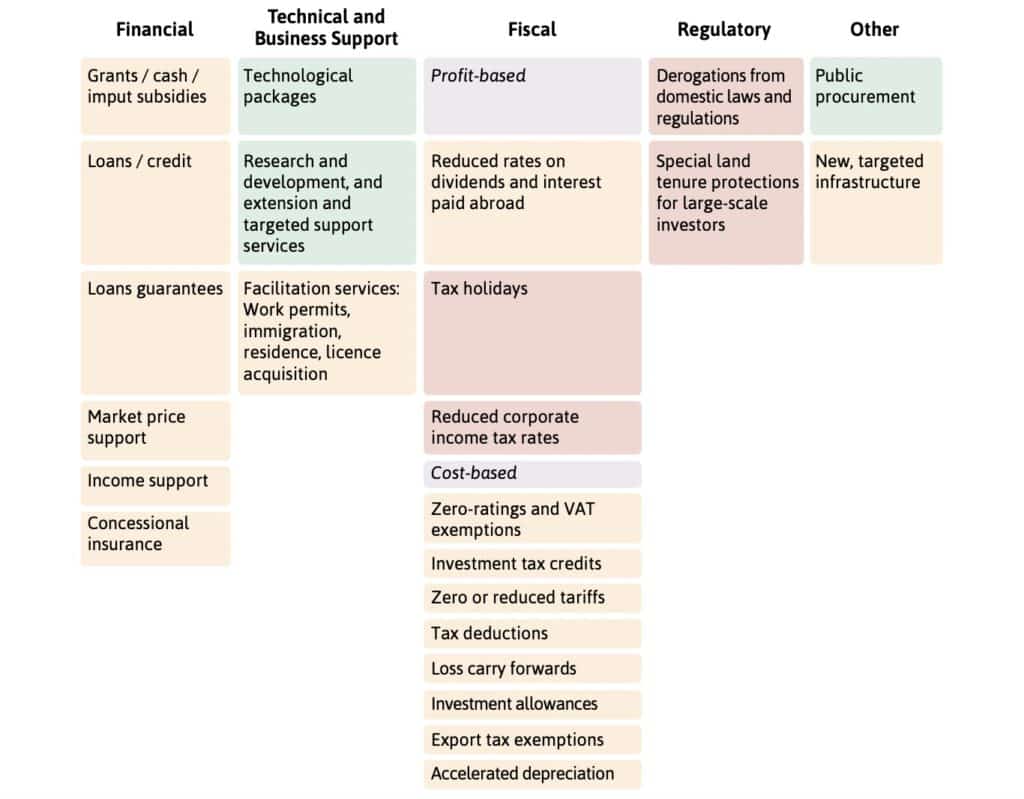
Investment incentives can be broadly categorized into five groups:
The guide examines common types of incentives used in the agricultural and food systems context that fall within those categories. It provides general guidance on those incentives that are inefficient or carry an excessive risk of negative externalities (red), those that have the potential to be good or bad policy tools depending on how they are used (amber), and those that may be more likely to have positive investment outcomes if used well, albeit still with risks of negative externalities (green).
The types of incentives examined are: