A Specialized Guarantee Facility for Industrial Decarbonization: The Case for a Dedicated, Pooled Risk-Sharing Instrument
This blog was originally published on Illuminem, and has been co-authored with Rhian-Mari Thomas. She is the CEO...

This blog was originally published on Illuminem, and has been co-authored with Rhian-Mari Thomas. She is the CEO...



The global transition to renewable energy systems will be mineral intensive and, under the current linear economy conditions,...


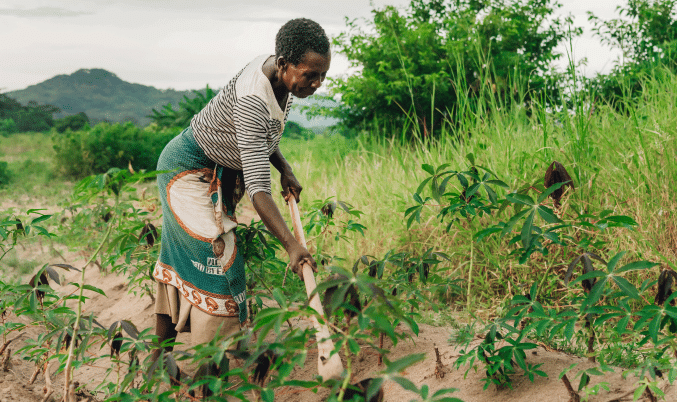
Agriculture is central to life in Sub-Saharan Africa (SSA). More than 60% of the entire population works in agriculture, most of whom are smallholders accounting for 80% of all farms in SSA. Yet, agriculture is one of the sectors most vulnerable to climate change. Severe drought, flooding, and extreme heat are becoming more frequent and intense, exacerbating the region’s existing vulnerabilities to food insecurity and water scarcity.
With the global rise of artificial intelligence (AI), its use in agriculture offers a way to harness technology and data to mitigate climate risks, improve productivity, and build long-term resilience. In SSA today, the AI applications being developed and used in agriculture are mainly for crop and weather monitoring, resource management, and digital advisory. Farmers access AI tools via mobile apps, SMS, and Interactive Voice Response (IVR) channels. In SSA, agri-tech investments have grown from less than USD $10 million in 2014 to $206.9 million in 2024. However, in 2025 investments fell by nearly 20% to under $170 million, suggesting that agricultural AI has yet to establish the foothold needed for a sustained financing base.
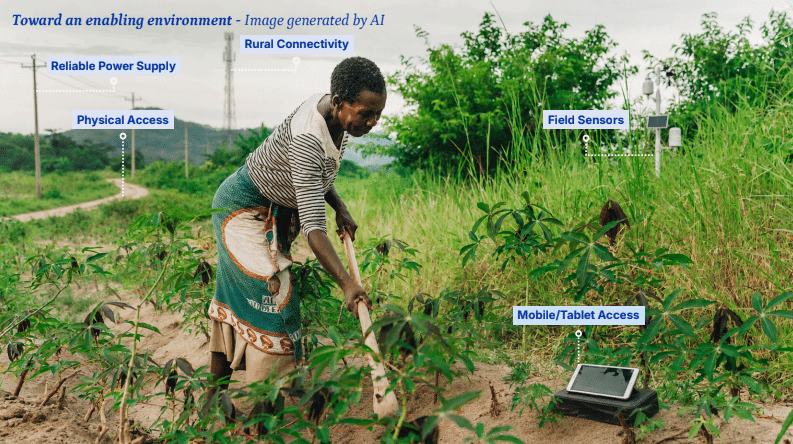
Despite SSA’s growing interest in agricultural AI, its adoption and value for farmers depends not just on technology, but whether the right conditions for its use exist. These conditions include clear governance frameworks, reliable infrastructure, usable data, financing, and accessible delivery pathways for farmers. Beyond that, farmers must be able to trust the wider system. Clear rules around data use and standards, as well as safeguards against harm are equally as important. Without these foundations, AI is promising in theory but difficult for farmers to actually use or benefit from.
This blog unpacks the enabling environment needed for AI adoption within agriculture in SSA, and its implications for smallholder farmers. It draws on Nigeria and Rwanda as illustrative cases. Nigeria is one of Africa’s largest economies and most populous countries, while Rwanda is a smaller, fast-growing economy with a much smaller population. Nigeria also has a larger data-hosting base, with roughly twenty data centers compared to only a few in Rwanda. This matters because data centers support the storage, processing, and scaling of digital and AI systems. Together, these cases provide a useful comparison of how agricultural AI may develop across markets that differ in scale, economic size, infrastructure depth, and national context.
Agricultural AI is gaining traction across the region. Governments are increasingly positioning AI as part of their agricultural transformation, and agri-tech funding has grown significantly over the past decade. At present, 14 SSA countries have national AI strategies or policies, with agriculture identified as a priority sector. These policies signal intent but are high-level and legally nonbinding. They outline broad goals but often lack the concrete mechanisms needed for execution. At the same time, there are currently no binding laws or regulations in SSA that govern the use of AI in agriculture. Regional institutions have recognized these gaps. The African Union’s Continental AI Strategy, Digital Transformation Strategy for Africa, and African Digital Compact have called for stronger regulatory clarity around agricultural AI’s development and use, especially around data, ethics, and responsible innovation. Despite this, concrete implementation guidance for deploying agricultural AI is still lacking.
This gap is also visible in financing. Development finance continues to support AI research and pilot programs, but there is limited private investment to help scale tools and technologies. Governments, development agencies, and philanthropic organizations are key funders. For example, the AI4D Africa initiative supports AI R&D across the region, while the African Development Bank funds digital and tech-driven agricultural programs under its Feed Africa strategy. The emerging AI startup landscape is attracting investments from international tech giants like Google and Microsoft, but broader private investment remains limited.
Taken together, this regional picture shows growing momentum but also implementation gaps in agricultural AI. This becomes clearer when looking at how these shortfalls play out in specific country contexts, particularly Nigeria and Rwanda.
The first barrier is the lack of clear legal, regulatory, and policy frameworks for how AI is developed, deployed, and held accountable. Governance frameworks are important as they define who is responsible for implementation, how data is collected and used, what infrastructure is needed, and how public and private actors coordinate. Policy also guides investment through regulatory clarity and incentives.
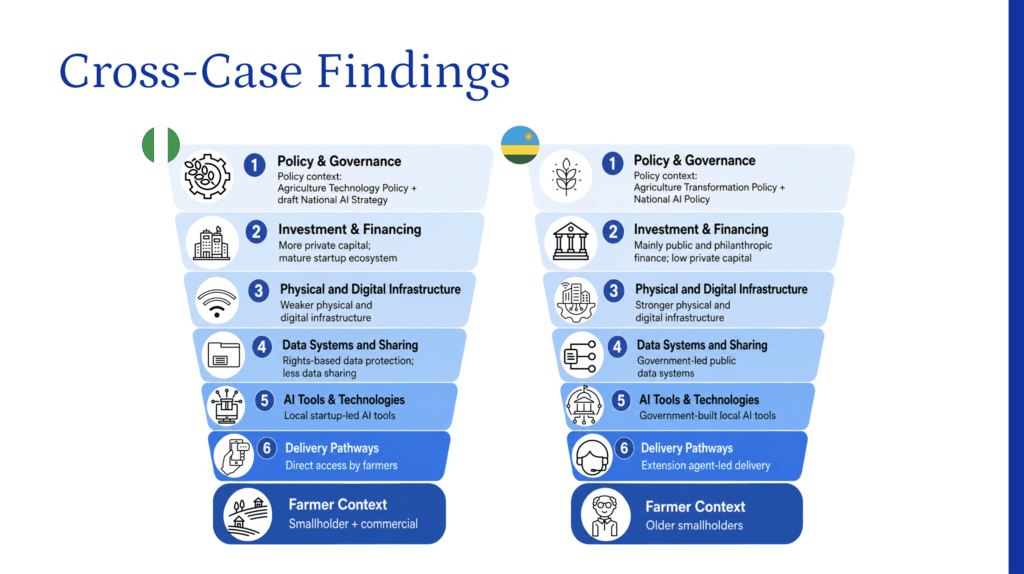
Nigeria and Rwanda illustrate two different approaches to AI governance. Rwanda’s is centralized with more well-defined policies: its National AI Policy sets a cross-sector vision for AI, while its Strategic Plan for Agriculture Transformation 5 (PSTA 5) embeds digitization and AI within agricultural development. Both policies articulate clear budgets, implementation pathways, and responsibilities across several key government institutions. Similarly, Nigeria’s National AI Strategy sets a cross-sector framework and is currently awaiting full parliamentary approval, and its National Agricultural Technology and Innovation Policy (NATIP 2022–2027) emphasizes modernization and digital agriculture. However, both policies lack specificity on implementation plans and responsibilities are distributed across more institutions with less clearly defined boundaries between them. This gives Nigeria a broader institutional base, but also makes coordination and implementation more difficult in practice.
Key issues in AI governance have emerged around data ownership, fairness in how AI systems affect farmers, and liability when AI-driven decisions or tools cause harm or fail. If a farmer shares crop data through an AI tool, who can control or profit from that data—the farmer or the AI company? If an AI tool gives wrong planting advice leading to crop loss, is the AI company or extension agent who spoke to the farmer responsible, or does the farmer bear all the risk? Neither Rwanda nor Nigeria has clearly defined these issues in their policies, and this uncertainty can negatively impact technology development, investment, and farmer trust. For AI developers, unclear expectations around liability, data rights, and accountability raise the costs and risks of entering the market. For investors, unpredictable governance conditions make opportunities harder to assess and back with confidence. For smallholder farmers, these same issues can erode trust and reduce adoption.
A second barrier is the underdevelopment of the digital and physical infrastructure on which agricultural AI depends, such as reliable internet connectivity, electricity, and functional digital platforms needed for AI to function. Power outages and poor connectivity make AI tools unreliable for farmers. They also shrink the addressable market, making it harder to attract investors. Here, Rwanda and Nigeria contrast: Rwanda has reached ~95% fourth-generation (4G) coverage, and invested in national fiber optic backbone expansion and a national data center. This creates a stronger base for digital public systems and AI deployment. On the other hand, Nigeria’s 4G coverage is ~53%, and broadband expansion has been slowed by high right-of-way costs, uneven state implementation, and the absence of an open-access national backbone network. These constraints raise connectivity costs and limit access beyond major urban areas.
A third barrier is the weakness of the data foundations on which agricultural AI is built.
Agricultural AI depends not only on high-quality data, but also on the systems that shape how data is collected, stored, shared, and protected. If a weather agency holds rainfall data, a ministry holds crop records, and an AI platform holds farmer-level data, but each uses different formats, labels, or databases, the data cannot easily be shared or used together. This raises integration and customization costs, making AI tools more expensive to build and harder to expand. Rwanda and Nigeria have different approaches to this challenge. Rwanda’s model is more state-led with greater emphasis on public data systems that can connect and share information, treating data as a national asset. This is also reflected in Rwanda’s Digital Public Infrastructure (DPI) strategy, which seeks to create a shared digital foundation for data exchange, service delivery, and cross-institutional coordination. In contrast, Nigeria’s framework is stronger on legal protection and data subject rights but less clearly tied to an operational system for data sharing. Thus, Rwanda’s more centralized digital governance model puts it in a stronger position to coordinate agricultural data across public institutions.
A fourth barrier is that investment in agricultural AI across SSA remains both limited and uneven, and does not always support the kinds of deployment pathways needed for smallholder adoption. Rwanda and Nigeria are building government-backed AI innovation ecosystems called AI Scaling Hubs, which are both supported by the Gates Foundation. Rwanda’s AI Scaling Hub has received about $17.5 million, and Nigeria’s AI Scaling Hub with $7.5 million. These hubs are designed to develop and scale AI solutions in key national sectors such as agriculture.
However, Rwanda and Nigeria’s innovation and financing models differ. In Rwanda, agricultural AI is more government-led and locally oriented. Development is tied closely to public systems and local delivery channels. For example, the Ministry of Agriculture and Animal Resources’s (MINAGRI) AI voice assistant, provides farmers with round-the-clock agricultural guidance free-of-charge. However, private investment has played a smaller role than public financing. 90% of Rwanda’s farmer base are smallholders, limiting the scope for commercialization and weakening the incentives for profit-seeking investors. Yet, relying primarily on public financing can have risks. Rwanda’s National AI Policy estimates full implementation to cost US $76.5 million, but less than US $19 million has been mobilized so far. This highlights a large funding gap and challenges the long-term sustainability of a heavily state-led model. Nigeria, by contrast, has a more active private- and startup-led ecosystem, with the fourth-largest startup market in Africa and the second-highest level of private-sector investments on the continent. Although around 70% of its farmers are smallholders, Nigeria’s much larger population and agricultural sector create more commercial farms and greater scope for market-based solutions. In particular, Nigeria’s strength lies in its developed entrepreneurial ecosystem, having the most startups in SSA. Initiatives such as NITDA’s Agriculture Demonstration Project, the Nigeria Artificial Intelligence Research Scheme (NAIRS), and the NCAIR AI Fund, launched with Google in 2024, point towards stronger ecosystem-building around AI research, startup support, and commercial experimentation. However, financing is mainly concentrated at the pilot stage for R&D, rather than towards scaling pathways for wider adoption.
Rwanda and Nigeria show that stronger policy does not automatically lead to stronger investment, and stronger private-sector activity does not automatically lead to smallholder adoption. Rwanda has clearer public direction, but limited private financing. Nigeria has more startup activity and commercial experimentation, but this does not guarantee that tools will reach smallholders in affordable or accessible ways.
A fifth barrier is that many of the intended users of agricultural AI face practical constraints that make adoption difficult. Across SSA, many smallholder farmers still face low digital literacy, limited trust in unfamiliar technologies, and basic infrastructure barriers such as unreliable internet access and limited access to mobile devices. For example, phones are often shared within households and communities rather than individually owned, making it harder for farmers to consistently access AI tools.
Additionally, there is a further dimension of legal and institutional exclusion. At least 10% of smallholders farm under customary or informal arrangements rather than documented land rights and may lack needed records and documentation. If farmers cannot prove land claims, verify their identity, or document their farming activities, they may be less willing to use or even be wholly excluded from access to AI tools that require formal registration. More secure land rights can help address this issue and also provide a stronger sense of ownership and greater confidence for farmers to invest in their land and in agricultural AI technologies.
In Rwanda, the adoption challenge is also shaped by a demographic mismatch between the country’s farming population and the age group most proficient with digital tools. Youth have a much higher digital literacy and use AI more than older people. However, farmers aged 16-30 account for only 14% of the agricultural workforce as many are uninterested in working in agriculture. This creates a gap where AI users do not match the farmer base. Rwanda is working to address this by focusing the delivery of AI tools through traditional extension agents instead. When MINAGRI develops in-house tools such as crop production forecasting, extension agents then share the AI insights with farmers rather than have them directly access information, thereby bridging this digital gap.
Nigeria presents a different pattern. Smallholders face similar challenges, but given that 70% of the population is under 30 years old, its greater share of younger farmers creates more potential for direct farmer engagement with AI tools. Nigeria’s startup-led ecosystem does just that, developing technologies for direct farmer access. This creates more room for experimentation and a diversity of solutions, but can raise an affordability issue. Public delivery models provide support at little or no direct cost to farmers, whereas private-sector models may depend more on paid services that many smallholders cannot easily afford.
Rwanda and Nigeria show that to reach farmers, agricultural AI cannot be driven only publicly or privately. Rwanda highlights that stronger policies, infrastructure, and public coordination can help AI reach smallholders; however, it also faces clear funding limits that threaten long term sustainability. Nigeria shows the opposite risk. A more startup- and private-sector-led ecosystem can create innovation, but can also concentrate activity in pilot stages, commercially attractive users, or paid services that smallholders cannot afford, especially when policy and infrastructure support for smallholders are lacking. Neither model, in isolation, is sufficient. Hence, we offer several recommendations to address these challenges.
First, governments should establish clearer governance frameworks for agricultural AI.
Rather than simply listing agriculture as a priority area in broad AI strategies, governments should turn these high-level commitments into clearer rules for agricultural AI. This should include cross-sector and agriculture-specific laws, regulations, and policies on institutional mandates, data ownership and access, deployment standards, and responsibility when AI systems fail or cause harm. This would not necessarily resolve every governance gap, but would help clarify responsibilities and expectations for developers, investors, and farmers.
Second, build the foundations for AI before pushing AI itself.
In many parts of SSA, the binding constraint is not the absence of AI tools, but the lack of infrastructure and data systems those tools rely on. Governments and funders should sequence investment by first strengthening electricity, connectivity, digital platforms, and interoperable data systems, before focusing on scaling AI technologies. This sequencing would create a more reliable base for adoption and make later AI investment more effective.
Third, public and private finance should be combined more deliberately around smallholder adoption.
Public funding is still needed for the basic conditions that smallholders depend on, such as infrastructure, extension services, and early-stage deployment. But a largely public model is difficult to sustain over time when budgets are limited, as Rwanda’s funding gap suggests. A more durable approach is therefore to combine public and donor support for public goods with private capital for scaling tools and services where viable markets exist. This would help make agricultural AI both more inclusive in the short term and more sustainable over time.
Fourth, ecosystem-building should prioritize delivery, not just innovation.
A stronger startup ecosystem or more private investment does not itself ensure smallholders will be reached. In practice, private actors are often incentivized to focus on building new tools and targeting more monetizable users. Therefore, smallholder inclusion should be made an explicit financing objective rather than an assumed by-product of innovation. Governments can do this through laws, licensing requirements, procurement rules, and funding conditions that reward not only innovation, but also affordability, accessibility, and farmer reach. Tools for smallholders may become commercially viable over time, but they will first need support that reduces early market risk and aligns investor incentives with inclusion.
Finally, design agricultural AI around farmer demographics and real access conditions.
Delivery models should reflect who farmers are, how they access information, and what constraints they face in practice. In Rwanda where the farming population is older and less likely to engage directly with digital tools, extension-led delivery is effective. In Nigeria where a younger farmer base creates more opportunities for direct engagement, digital tools have greater reach though can be limited if infrastructure barriers, affordability constraints, or weak device access persist. Agricultural AI should therefore be designed around actual user conditions, with the delivery channel matched to demographic realities rather than assumed digital readiness.
Agricultural AI could play an important role in SSA’s agricultural future, but only if the right conditions are put in place now. As policy attention, investment, and experimentation grow, this is a pivotal moment to address the gaps in governance, infrastructure, data systems, and delivery that still constrain adoption. Tackling these challenges early would allow agricultural AI to support more resilient, productive, and inclusive agricultural systems, and to generate real value for the smallholders at the center of SSA’s food systems.
This research was made possible through the Columbia Climate School Collaborative Research Grant.
Slide Deck