Further Reading

This blog was originally published on Illuminem, and has been co-authored with Rhian-Mari Thomas. She is the CEO...



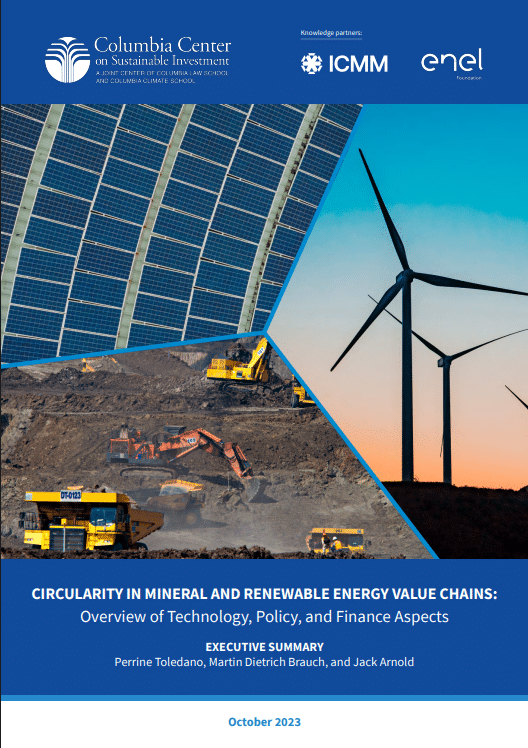
The global transition to renewable energy systems will be mineral intensive and, under the current linear economy conditions,...

Date: Sep 24, 2025
Time: EDT
Location: Interchurch Center, 475 Riverside Drive, New York, NY 10115, (enter at 61 Claremont Ave), Lobby Meeting Rooms A, B, C, and D
The energy transition offers countries a defining development opportunity by building industries for manufactured goods in value chains for energy technologies.
Attendees heard from experts at the Columbia Center on Sustainable Investment (CCSI), LSE’s Centre for Economic Transition Expertise, and Harvard’s Growth Lab about their work helping different countries build an industrial base in clean energy technologies and attract energy-intensive industries using renewable electricity.
Opening remarks were provided by Rt Hon Chris Skidmore OBE, former Minister for Business, Energy and Industrial Strategy (United Kingdom), Salata Climate Action Fellow at Harvard, and Chair of CETEx.
3:00–3:50 pm
Facilitator:
Perrine Toledano, Director of Research and Policy, CCSI
Panelists:
Martin Dietrich Brauch, Lead Researcher, CCSI
Laura Garcia Cancino, Senior Legal Researcher, CCSI
Ketan Ahuja, Harvard Growth Lab
Hugh Miller, Critical Mineral Lead, CETEx
To decarbonize, the world needs many more wind turbines, solar panels, electric vehicles, batteries, heat pumps, and other energy technologies. Places that manufacture these goods (or their inputs) will be well-positioned to win the industries of the future. This requires well-thought-out industrial policies grounded in market analysis, cost of capital, competitive advantages, and cost-benefit assessments, as well as attention to technological capabilities, supply chain resilience, and infrastructure needs. Some emerging markets and developing economies (EMDEs) are taking up this effort in response to the demands of the new economy.
This session featured three 15-minute presentations followed by a 5-minute Q&A session.
CCSI provided an overview of trends in international negotiations involving critical minerals and profile industrial policy initiatives in critical minerals value chains in Indonesia, Mexico, and South Africa, drawing from a market assessment prepared for the United Nations Industrial Development Organization (UNIDO). The Growth Lab demonstrated its Greenplexity tool—which helps countries understand economic opportunities in green value chains—with a focus on the same countries. CETEx presented its upcoming work analyzing the effectiveness of stockpiling to mitigate supply risks, the case for international coordination on stockpiling, and implications for the resilience of green value chains.
3:50–4:40 pm
Facilitator:
Sini Matikainen, Director for Economic and Fiscal Policy, CETEx
Panelists:
Perrine Toledano, Director of Research and Policy, CCSI
Ketan Ahuja, Harvard Growth Lab
Eric Verhoogen, Professor, Columbia University
Francisco Carlos Manesco Junior, Manager, Strategic Mining Projects, Vale
Renewable power now represents the cheapest, fastest-growing form of electricity. As industry decarbonizes and electrifies, it will increasingly gravitate toward countries with cheap and plentiful renewable electricity. Attendees heard from experts about how to turn this trend into actionable development strategies and learned about case studies showcasing how industries have successfully deployed clean energy technologies in EMDEs.
This session featured four 10-minute presentations followed by a 5-minute Q&A session.
CCSI presented its concept of a mining–energy–industry feedback loop, and the Growth Lab shared learnings from its work on attracting heavy industry with renewables. Columbia Professor Eric Verhoogen presented research on knowledge externalities in the adoption of an energy-efficient motor by leather goods firms in Bangladesh, and Vale presented its renewable-powered Waste to Value program to recover iron ore from tailings dams in Brazil.