Time and Compromise in UNCITRAL’s Working Group III
During the week of 22 September 2025, States once again met in Vienna under Working Group III (WGIII)...
During the week of 22 September 2025, States once again met in Vienna under Working Group III (WGIII)...


The global transition to renewable energy systems will be mineral intensive and, under the current linear economy conditions,...


This piece was originally published on EJIL: Talk!
Ecuador is once again at the centre of global debates on investor–State dispute settlement (ISDS). In December 2025, President Noboa signed a Bilateral Investment Treaty (BIT) with the United Arab Emirates (UAE) that re‑introduces ISDS into a legal order which, since 2008, has constitutionally prohibited the State from ceding “sovereign jurisdiction” to international arbitration in disputes with private foreign parties (Article 422).
What makes this BIT remarkable is how it is being forced through despite clear constitutional text and two recent referenda rejecting ISDS. Via executive decrees, procedural shortcuts, and deliberate sidelining of constitutional safeguards, the Noboa administration and the Constitutional Court are acting in full knowledge that ISDS treaties are unconstitutional under Article 422 and that voters have twice refused to authorise a change to that rule. The UAE-Ecuador BIT risks becoming the precedent that normalises routing ISDS around constitutional and democratic safeguards, thereby paving the way for other agreements, including the Canada-Ecuador Free Trade Agreement (FTA).
Article 422 of Ecuador’s 2008 Constitution was drafted to prevent repetition of Ecuador’s costly experience with investment arbitration. By 2008, Ecuador was subject to at least 13 ISDS cases. In Occidental v. Ecuador, for instance, a tribunal awarded the investor $ 2.3 billion—an amount equal to roughly 59% of Ecuador’s education budget and 135% of the health budget that year—after Ecuador terminated an oil concession for an undisclosed transfer of rights.
Article 422 has held up politically. In April 2024, President Noboa sought to reopen the question through a security‑framed referendum. Among questions on criminal and security policy, there was a proposal to amend the clause and allow international arbitration: 65% of voters rejected it. In November 2025, in another referendum, 62% of voters rejected a constituent assembly proposal widely understood as a path to dismantling Article 422 as well as other constitutional protections.
The sequence matters: the government sought explicit authority to amend Article 422 and failed; then sought to rewrite the Constitution altogether and failed. Only after these defeats did it turn to fast-tracking a BIT with ISDS through executive and judicial maneuvers.
The Noboa administration’s conduct demonstrates it understands treaties with ISDS are unconstitutional under current law. First, by requesting the April 2024 referendum to amend Article 422, the President acknowledged that the existing text blocks ISDS, i.e., “Que el texto del art. 422 de la Constitución es un obstáculo a la inversión extranjera porque impide ofrecer a los inversionistas un entorno de seguridad jurídica como si lo hacen otros países que mantienen tratados bilaterales de protección de inversiones y reglas de sujeción a los arbitrajes internacionales.” (“That the text of Article 422 of the Constitution is an obstacle to foreign investment because it prevents investors from being offered an environment of legal certainty, as is the case in other countries that have bilateral investment protection treaties and rules subject to international arbitration.”) The justification—that current wording prevents “legal certainty” for investors—rests on the premise that ISDS is not permitted. There would be no need to amend Article 422 if ISDS treaties were already constitutional.
Second, Ecuador concluded an FTA with Canada including ISDS, but it remains unsigned and unratified. It appears that both sides are waiting for Ecuador to resolve whether ISDS can be constitutionally reintroduced. The failed 2024 and 2025 referenda were attempts to create that domestic authorisation.
It appears, therefore, that the December 2025 UAE-Ecuador BIT is part of a wider strategy: once one ISDS treaty survives constitutional scrutiny, it serves as precedent—political and jurisprudential—for validating others.
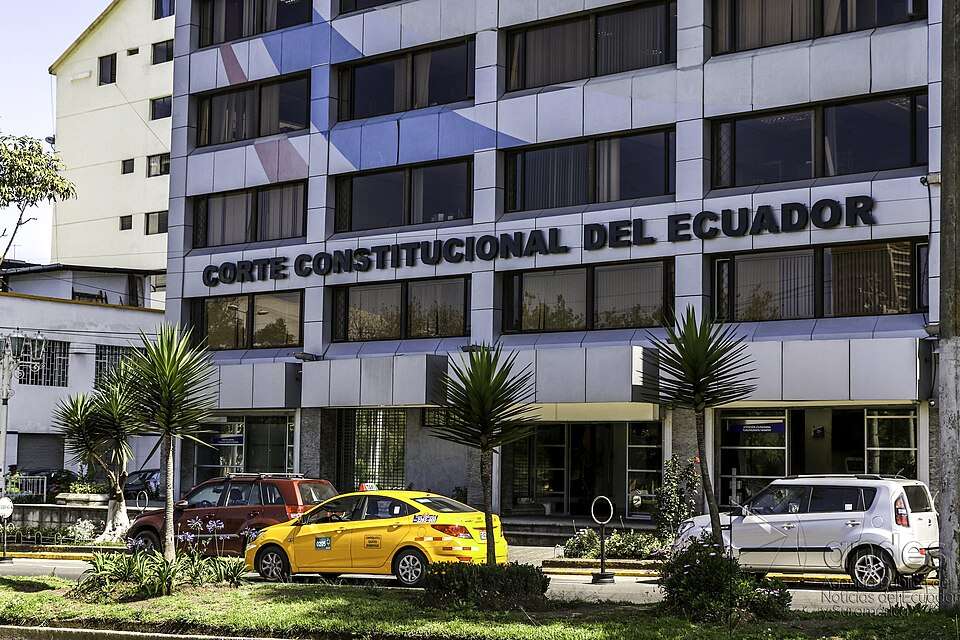
On 31 December 2025, during the holiday period, President Noboa submitted the UAE-Ecuador BIT to the Constitutional Court under an abbreviated procedure, giving it eight days to decide whether the treaty requires National Assembly approval under Article 419. Article 419 of Ecuador’s Constitution requires prior legislative approval for treaties that, among other grounds, transfer sovereign powers to international organisations, impact constitutional rights and guarantees, or create international financial obligations for the State. The executive’s request argues that the BIT falls outside these Article 419 categories and therefore may be ratified directly by the President without Assembly involvement. Interestingly, the submission frames the question as legislative approval only, without asking the Court to assess Article 422 compatibility—the provision that explicitly prohibits ceding sovereign jurisdiction to international arbitration. The executive seeks judicial authorisation to bypass the legislature while sidelining the constitutional prohibition on ISDS.
Civil society organisations, Indigenous groups, academics, and individuals inundated the Court with amicus curiae submissions arguing that the BIT clearly triggers Article 419 (including transfer of sovereign powers, impact on constitutional rights and guarantees, and creation of international financial obligations) and is substantively incompatible with Article 422 and both referenda outcomes. The wave of amicus submissions and public mobilisation—responding to what many viewed as an attempt to fast-track ratification while citizens were on holiday—appears to have derailed the executive’s strategy. The Court has not issued a decision within the eight-day window, suggesting the attempt to secure quiet approval failed in the face of sustained civil society opposition.
Rather than treat these submissions as confirmation that comprehensive constitutional scrutiny is required, the Court’s subsequent actions suggest an effort to manage (or avoid), rather than confront, the core issue.
The case was assigned to Judge Claudia Salgado, who was appointed under Noboa last year. Following Ecuadorian Constitutional Court procedure for Article 419 reviews, the presiding judge drafts the opinion, which the full nine-member Court then either affirms or rejects. While Salgado has publicly expressed doubts about the constitutionality of ISDS in treaties under Ecuador’s current Constitution, she has taken steps sustaining the fiction that the BIT is primarily a procedural question under Article 419(7): requiring prior approval by the National Assembly if the treaty “attributes powers of a domestic legal nature to international or supranational organizations”.
On 15 January 2026, the Court requested from the Attorney General’s office a complete list of all BIT-based cases and contract-based arbitrations involving the State—including non-public cases, with “express indication, in each case, … whether or not the international responsibility of the State was declared”. The explicit focus on whether Ecuador’s “international responsibility” was declared in arbitration cases signals the Court’s likely strategy: to argue that ISDS adjudicates breaches of international law (treaty violations establishing State responsibility), a competence domestic courts never possessed. This framing would allow the Court to conclude via Article 419(7) that domestic courts lack competence to adjudicate breaches of international law—a power reserved to international organisations. Since Ecuadorian courts never possessed this authority, allowing arbitral tribunals to determine treaty violations does not “transfer” competence; it merely assigns what was never domestically held. Under this logic, there is no transfer requiring legislative approval.
The circularity is stark: a provision designed to prevent cession of domestic powers is reinterpreted to exclude anything deemed “international”, rendering Article 419(7) a dead letter—precisely what it was meant to prevent. Absent ISDS, investor-State disputes would be heard in Ecuadorian courts applying Ecuadorian law; ISDS transfers that competence to international arbitration. Yet the Court appears to be constructing an argument that no transfer will occur because investor-State law is “inherently international”. By defining away the domestic origin of competence, the Court transforms a constitutional constraint into a tautology: Article 419(7) can never apply because delegated competence is always recharacterised as “international”.
In the meantime, textual errors in the BIT exposed the strategy’s fragility. A public tweet noted that the UAE is misnamed as “United Arab States,” which is not a State, while an amicus submission pointed out that Article 25(1) of the treaty references a non‑existent paragraph 3. On 26 January 2026, the Court gave the President three days to provide the full English text—raising the curious question of why Ecuador’s highest court would need a non-official language version to assess domestic legal compliance.
Rather than submit the English original, President Noboa issued Executive Decree No. 294 on 28 January 2026, while abroad, authorising Ecuador’s ambassador to sign an “errata sheet” correcting “formal and translation errors”. The next day, the executive requested a 15‑working‑day extension; the Court granted the request on 30 January 2026. The government later admitted in media that the English-language version also contained errors—not merely translation problems—underscoring the haste with which the treaty was negotiated and signed, and the speed with which the administration hoped to rush it to ratification.
What is remarkable here is not treaty correction, but the cascade of procedural irregularities. The BIT was rushed to signature without legal vetting, submitted on 31 December 2025 under an expedited procedure requesting an eight-day decision on whether Article 419 legislative approval applies (a decision still pending), and was slated for revision mid-review via unilateral executive decree. Textual defects in both the Spanish and English versions exposed the haste with which the treaty was negotiated and signed. The deeper problem, however, is what this chaos obscures: the substantive unconstitutionality at its core. While managing textual errors, the executive and Court ignore that ISDS provisions are illegal under Article 422 and opposed by two recent referenda. By attending to orthography while sidestepping constitutional prohibition, both branches appear to be privileging form over substance.
The insistence on this BIT, and particularly the inclusion of ISDS provisions, is difficult to explain in purely legal or economic terms. For instance, Canadian investment actually tripled in the five years after the 1997 investment treaty with Canada was terminated in 2017. Moreover, Ecuador has negotiated and signed new agreements with the European Union and South Korea, and ratified ones with the European Free Trade Association and China without ISDS, demonstrating that such mechanisms are not necessary to attract foreign investment or secure treaties. Yet the strategic purpose of validating ISDS in the UAE BIT becomes clear when viewed as precedent: once the Court approves one ISDS treaty through narrow procedural framing, others, like the pending Canada-Ecuador FTA—which includes ISDS but remains unsigned—becomes trivially easy to ratify using the same logic.
The UAE BIT’s structure confirms this intent. First, the BIT extends ISDS coverage to extractive sectors where conflicts with Indigenous rights and environmental protection are most acute. But the core illegality is not the absence of investor obligations—though the treaty contains none—it is ISDS itself, which Article 422 prohibits regardless of what ancillary obligations any treaty might contain. Second, its broad asset-based definition of “investment” is followed by an illustrative list that appears to (erroneously) cover Emirati exploration and exploitation of Ecuador’s natural resources, but not comparable Ecuadorian investments in the UAE. This asymmetry is striking: why would Ecuador accept such imbalance, and why would the UAE negotiate a carve-out through what is merely an illustrative list, rendering it meaningless?
Third, the timing is revealing. On 28 January 2026—the same day Executive Decree 294 authorised corrections to the UAE BIT—Noboa submitted a proposal to the Assembly to reform the Mining Law, including the elimination of the environmental license requirement for mining projects and its replacement with a weaker “environmental authorisation”. Environmental licenses have been the primary tool through which courts and communities have enforced constitutional rights, especially the collective right recognised in Article 57 of the Constitution, which guarantees Indigenous peoples free, prior, and informed consent over extractive projects on their lands and protects the rights of nature. Eliminating them while locking in ISDS provisions that penalise future re-regulation represents an integrated strategy. The government deregulates domestically to strip communities of the tools for enforcing constitutional rights, then uses international law and ISDS to make any potential reversal financially ruinous.
The UAE-Ecuador BIT tests Ecuador’s constitutional integrity. The executive knows Article 422 bars ISDS; voters have twice refused authorisation. Yet the Constitutional Court narrows review to Article 419, accommodates treaty revisions mid-proceedings, and constructs doctrinal exits to reconcile ISDS with a provision designed to prohibit it. If endorsed, this strategy demonstrates that constitutional prohibitions and popular mandates can be neutralised through procedural framing and definitional manipulation rather than democratic debate.
The alternative path remains available. Recognising the UAE-Ecuador BIT as requiring Assembly approval under Article 419 and incompatible with Article 422—interpreted in light of the 2008 Constitution, the 2024/2025 referenda, and the Court’s own precedent in the Ecuador-Costa Rica FTA review—would reaffirm that treaty-making power is constrained by constitutional text and popular will. It would not foreclose future investment policy debate but would insist that any departure from Article 422 occur through transparent, democratically accountable processes, rather than executive-judicial workarounds.
At stake is whether Article 422 and the referenda defending it remain meaningful expressions of sovereign choice—or whether the UAE-Ecuador BIT becomes the instrument through which that choice is quietly reversed.
International Investment Law / Blog