





Mining, Metals and Resource-based Development
Secure Land Rights Are Now More Important than Ever
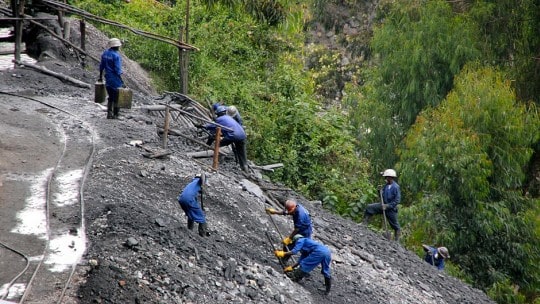
Tungsten surface mining in Rwanda, a country among the top exporters of tungsten. In the wake of COVID-19 low-income countries are increasingly looking to take advantage of their untapped natural resources.
(Photo: Fairphone, via Flickr, CC BY-NC 2.0)
As the COVID-19 pandemic continues into its second year, its impacts continue to grow, exposing many of the flaws, vulnerabilities, and inequalities inherent in our governance and economic systems.
While many are hopeful that the pandemic has precipitated a global shift away from harmful business-as-usual practices, the immediate economic impacts and financial burdens caused by the crisis are placing significant pressure on governments to find quick-fix solutions to kick-start their economies.
This pressure is particularly acute for low-income countries shouldering significant debt burdens, where immediate relief and easily mobilised income are increasingly seen to lie in accessing the potential of yet untapped natural resources.
The decisions taken now regarding how these resources are used and accessed will shape our world for years to come, significantly impacting and influencing responses to issues such as climate change, biodiversity loss, and achievement of the Sustainable Development Goals.
Dangerous backsliding
Managed responsibly, facilitating natural resource-based investments for economic recovery could provide the much needed (and much talked about) pivot towards doing things differently in the post-COVID world. Before this crisis, business-as-usual models for natural resource exploitation failed to bring about sustainable growth and, in many ways, helped to lead us to the current precipice of the larger climate crisis, of which the pandemic is merely a symptom (PDF). A new approach is critical.
But alarmingly, it appears that in the rush to implement economic stimulus packages and encourage investment in the natural resource sectors, countries are backsliding on important pre-COVID environmental and social safeguards. We have seen weakened environmental impact assessments, compressed or limited community consultations, the opening up of Indigenous lands and protected areas, as well as relaxed licensing requirements.
These pose serious risks, threatening to erode vital positive gains made towards achieving responsible land-based investments that support climate action.
“Only a crisis – actual or perceived produces real change. When that crisis occurs, the actions that are taken depend on the ideas that are lying around” – Milton Friedman
Although uttered by the darling of neoliberal thinking, it is precisely the ‘ideas lying around’, or maybe rather the available capabilities as described by Amartya Sen, that will shape the post-COVID-19 world. The paths we choose now will indeed determine our direction for years to come.
Generating some of these much-needed ideas, the Columbia Center on Sustainable Investment (CCSI), IIED, and Namati have been at the forefront of rethinking investment approaches and advocating for responsible land-based investments. The importance of secure land rights for post-COVID economic recovery, as well as climate mitigation and adaption, has been clearly established (PDF).
Supporting a shift
The ALIGN project, a collaboration between these three organisations, intends to build on this central role of land in advancing a truly sustainable and climate-sensitive post-COVID recovery. To do this, ALIGN is pursuing three key actions:
- Tracking trends: to support appropriate responses, it is necessary to know what is happening. To this end, ALIGN is tracking emerging issues and trends in investment-related land governance, focusing particularly on two regions – sub-Saharan Africa and the Indo-Pacific. The data we track provides a snapshot of what has happened over the past year, and what is happening right now – or at least what is being reported – to give us an idea of the changing COVID landscape and how it affects land governance and investments. This helps us identify the most important issues of the day and trends over time, and provides the basis for evidence-based decisions on where to target our work.
- Robust policy and legal framework support: well-formulated policies that provide clear, forward-facing sectoral roadmaps and robust legal frameworks that operationalise these visions are the foundation for attracting and regulating responsible, climate-sensitive investments in land. Ensuring governments have the capacity to formulate these frameworks and push back against short-term pressures is vital. Instead of rolling back social and environmental protections in the hopes of attracting more resource-based investment, governments should re-evaluate their sector policies. Shifts such as the decline of oil and the rise of renewables (PDF) highlight emerging alternatives. ALIGN will assist partner countries in identifying these alternatives and harnessing their potential.
- Translating policy into practice: robust policy and legal frameworks alone are not enough. Without the means to translate policy aspirations into action they will remain just that – aspiration. A clearly articulated plan for implementation and enforcement is critical. Land-based investments, including land-intensive climate solutions, will increase competition for land. Legal empowerment approaches that secure land rights are thus central to realising a just transition. ALIGN is providing technical assistance to support community legal empowerment and government implementation.
Global pandemics are watershed moments in human history. The ideas we adopt now will determine how effectively we are able respond to increasing global changes, of which COVID-19 is only one.
We have the tools and ability to build back better. Let us avoid the quick-fix solutions that rely on harmful investment practices and focus instead on using investment to support truly sustainable growth.
About the authors:
Tehtena Mebratu-Tsegaye is senior legal researcher for the Columbia Center on Sustainable Investment.
Nathaniah Jacobs (nathaniah.jacobs@iied.org) is senior researcher in IIED’s Natural Resources research group.
This blog was originally published on iied.org.