Time and Compromise in UNCITRAL’s Working Group III
During the week of 22 September 2025, States once again met in Vienna under Working Group III (WGIII)...
During the week of 22 September 2025, States once again met in Vienna under Working Group III (WGIII)...

The global transition to renewable energy systems will be mineral intensive and, under the current linear economy conditions,...


Mining, Metals and Resource-based Development

 +1
+1
Critical minerals production is essential for a net-zero future yet mining land footprint overlaps with sensitive ecosystems: of the sector’s 101,583 square kilometers of mining concessions, 7% are in biodiversity hotspots, 8% are in protected areas, and 16% are in “wilderness” areas of high ecological integrity.
The value chains of mining operations “both depend on and impact nature” (ICMM, 2024), creating a responsibility for mining actors to manage and mitigate the impacts of operations on the landscape. This responsibility includes addressing nature loss, supporting the well-being of communities, and contributing to the resilience of ecosystems.
Nature-based solutions (NbS), which are based on the idea that healthy ecosystems deliver valuable services to society, offer one method of working towards these goals.
*Societal challenges include climate change, (lack of) food and water security, human health, natural disasters, among others.
Informed by case study research about the uses of NbS in mining, CCSI proposes six resilience-building categories for NbS in the mining context, emphasizing NbS as a practical, impact-driven intervention. These categories identify how NbS work with specific natural resources to strengthen ecosystems and nature’s capacity to carry out its intended functions. These include:
The opportunities for NbS exist throughout the mining lifecycle, from exploration to closure and rehabilitation. While they may be applied in any phase, the planning phase remains particularly important for establishing their organization, method of integration, and strategic intent. Embedding NbS at an early stage offers an opportunity to mobilize the mitigation hierarchy from conception, prioritizing avoidance and impact minimization through land-use planning.
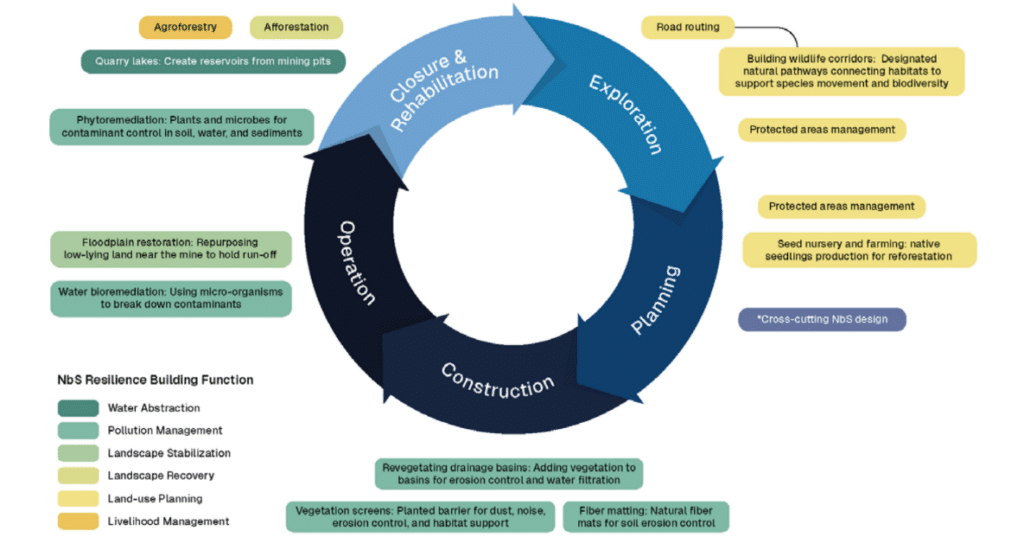
Planning and design phases are also a tremendous opportunity for interdisciplinary collaboration between companies, technical innovators, and communities, whose buy-in and sustained involvement are crucial to the initiative’s relevance and success. Including these various stakeholders in early-stage planning provides a practical opportunity to embed partnerships and identify each stakeholder’s leverage points before projects become path-dependent. During the planning phase, mining actors, in particular, have the opportunity to think systematically about where their interventions will be most strategic and impactful.
By integrating nature-conscious initiatives and land-use planning into practice, mining can demonstrate how industries who have traditionally been seen as part of the problem, can also be pivotal actors in mitigating environmental and ecological harm, innovating for climate resilience, and pursuing just transitions.
To explore how we get there, CCSI and Vale Base Metals held 3 events at Climate Week NYC and COP 30 in Belém, convening experts and practitioners from industry, civil society, finance, and innovation to discuss what NbS may look like in present and where the leverage points for nature-conscious interventions are. Discover our research and the conclusions of our events.
Document